Every Tour de France, mapped
All 2,427 stages of the men's Tour from 1903 to 2026, and all 42 of the Tour de France Femmes since 2022, drawn as lines from start to finish. How the race wandered: from a giant loop round the edge of France to Grand Départs in Dublin, Florence and Copenhagen. The towns it keeps coming back to, how far it strays abroad, and how it got shorter and faster.
The first Tour de France, in July 1903, had six stages. Riders left Paris for Lyon, then rode on to Marseille, Toulouse, Bordeaux and Nantes, and back to Paris: 2,428 km in all, an average of 405 km a stage. The race has been held 113 times, with breaks only for the two world wars, and every stage is recorded on the official Tour website. Thomas Camminady has gathered those pages into LeTourDataSet, a free table of every stage and every rider, and it is the source for everything here.
The table gives each stage's start and finish town, but not where they are. So I matched every name against GeoNames, a free gazetteer of the world's towns, and drew each stage as a straight line from start to finish. The result, below, is a portrait of more than a century of the race. Press play to watch each Tour drawn stage by stage in yellow, or click any town to see every stage it has hosted.
01 · The map2,427 stages, 701 towns
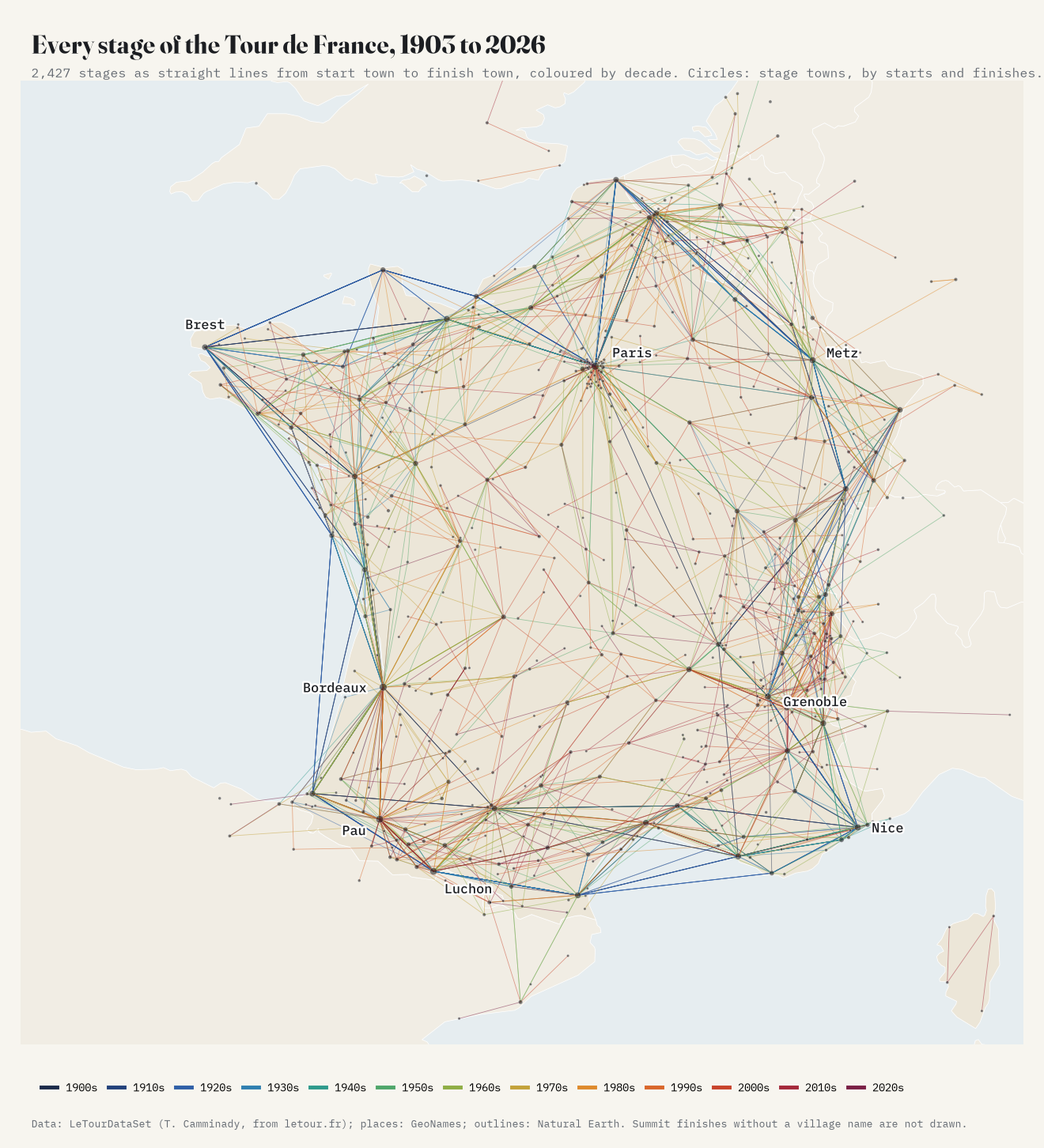
The interactive map could not start in this browser, so this is a static version.
Lines: each stage, straight from its start town to its finish town (the source has no routes), coloured by decade; the chosen Tour in yellow. Dashed lines (Transfers): the gap between one stage's finish and the next stage's start. Circles: stage towns, sized by starts and finishes. Stage towns are GeoNames places; 95.8% of the 4,938 starts and finishes are located, and summit finishes with no village in their name, such as the Puy de Dôme and Mont Ventoux, are left off. Source: LeTourDataSet by Thomas Camminady (MIT), from letour.fr. Places: GeoNames (CC BY 4.0). Outlines: Natural Earth. Relief tiles © Esri.
02 · The giant loopRound the edge, then across the middle
For its first half century the Tour was a tour in the literal sense: a lap of France. It ran round the coasts and frontiers, from the Channel to the Atlantic, over the Pyrenees, along the Mediterranean, up the Alps and across the north. In the 1920s, 92% of the French stage towns it used lay within 50 km of the coast or a land border, although that strip makes up only 37% of the country. In the 2020s the figure is 49%.
The early loop was also unbroken. Through the 1910s, 1920s and 1930s every stage began in the town where the last one had finished, so the route could be drawn without lifting the pen. That changed slowly after the war, then quickly. In the 1960s, 11% of stages began somewhere else; in the 2020s, 88% do, and the riders and their convoy are moved by bus, train or plane. Summed as straight lines, the gaps between finishes and next starts now add up to about 1,152 km a Tour. The longest single jump in the data is 681 km, from Espelette in the Basque Country to Houilles near Paris in 2018.
The loop, by decade
Bars: share of French stage towns (each start and finish counted) within 50 km of the coast or a land border; the dashed line is that strip's share of France's area. Line: share of stages that start in a different town from the previous finish. Hover or tap a decade.
03 · Shorter and fasterFrom 5,745 km to 3,333
The longest Tour was the 1926 edition: 5,745 km, in a decade when the race averaged 5,452 km and its stages 306 km. The winner, Lucien Buysse, was on his bike for 239 hours. The 2026 Tour covered 3,333 km in 21 stages, 42% less, with stages averaging 159 km, and its winner needed 74 hours.
Total distance and the winner's speed, every Tour
Bars: the official total distance of each Tour, coloured by decade. Dots: the overall winner's average speed (distance divided by time), only for Tours decided on time; from 1905 to 1912 the Tour was decided on points, and there is no winner in the official record for 1999 to 2005. Hover or tap a year.
The riders also got much faster. Maurice Garin won the first Tour at 25.7 km/h. The winners of the 1950s averaged 34.3 km/h, and those of the 2020s 42.1 km/h; the fastest of all was Tadej Pogačar in 2026, at 45.08 km/h. The data cannot say why. What it does show is a gap: the official record has no winner at all for 1999 to 2005, because those seven titles were stripped and never given to anyone else.
The source has no length for single stages, only each Tour's total. As the crow flies, the longest stages were the opening legs of 1903 and 1904, Paris to Lyon, 393 km in a straight line; the road was longer still. Across all stages with two located towns, the straight line from start to finish averages 122 km, and 148 stages, mostly time trials and circuits, started and finished in the same town.
04 · Stage townsParis, Bordeaux, Pau
The 2,427 stages of the men's Tour used 684 different towns, 287 of them (42%) only once. Paris is in a class of its own: 161 starts and finishes in 112 Tours. Every Tour has ended in Paris except 2024, when the Olympic Games were in the capital and the race finished in Nice, and 38 began there, including every Tour until the first Grand Départ elsewhere, in Évian in 1926. The next two are the gateways to the Pyrenees: Bordeaux, with 137 starts and finishes, and Pau, with 133, the most common start of all (69). Luchon, at the foot of the passes in the central Pyrenees, is fourth.
The most visited stage towns
Starts and finishes in the men's Tour, 1903 to 2026. Click a row to see the town on the map.
05 · Abroad27 Grand Départs outside France
The Tour first crossed a border in 1913, with a stage from Grenoble to Geneva. The first Grand Départ abroad came in 1954, in Amsterdam, and since then the race has started in 6 Dutch towns, 5 Belgian, 4 German and 3 Spanish, as well as in Luxembourg, Switzerland, Monaco, Ireland, Denmark, Italy and, twice, England. Starting abroad has become the norm: 14 of the 27 Tours since 2000 began outside France.
Stages abroad, every Tour
Stages that started or finished outside France, by the foreign country they touched (the start's, if both ends are abroad). Triangles mark Grand Départs abroad. Hover or tap a year.
In all, 304 stages (12.5%) started or finished in one of 12 other countries, and 209 (9.3% of those with both ends located) crossed a border. Belgium is the Tour's second home, with 118 stages touching it, ahead of Switzerland (51), Spain (29) and Italy (27). Brussels and Liège are the most visited towns outside France, with 25 and 24 starts and finishes. 34 of the 113 Tours never left France at all, at least at their located starts and finishes.
Every Grand Départ abroad
The start town of the first stage or prologue. Click a row to see that Tour on the map.
06 · DépartementsEvery one, at least once
Has the Tour been everywhere? Using the département GeoNames gives each French stage town, every one of the 96 départements of metropolitan France has hosted at least one start or finish. The busiest is Pyrénées-Atlantiques, home to Pau, Bayonne and the Aubisque, with 228 starts and finishes in 102 Tours, ahead of Haute-Garonne, which holds Luchon (224). The least visited are Deux-Sèvres, where only Niort (in 1950) appears among the located towns, and the two départements of Corsica, which waited until the 100th Tour in 2013. Turn on "Départements" in Map layers to shade them by visits. The data has no record of the towns a stage merely passed through, so this counts only starts and finishes.
07 · WinnersFrance 36, Belgium 18, Spain 12
LeTourDataSet's rider file lists the final classification of every Tour. It has no nationality column, so I added the nationality of each of the 64 overall winners by hand, and checked it against the national team that the file names for the 25 winners of the years when the Tour was raced by national teams. French riders won 36 Tours, the last in 1985, by Bernard Hinault. Belgium has 18, Spain 12, Italy 10, Britain 6, and Luxembourg and Slovenia 5 each. The first winner from outside France was François Faber of Luxembourg in 1909, and the first from outside Europe Greg LeMond of the United States in 1986. Five men have won five times: Jacques Anquetil, Eddy Merckx, Bernard Hinault, Miguel Indurain and Tadej Pogačar.
Who won, year by year
One cell per year, coloured by the winner's nation; blank cells are years without a Tour, hatched cells the seven years with no winner in the official record. Below: titles by nation. Hover or tap a cell.
The doping years
This page follows the official record as LeTourDataSet gives it. For 1999 to 2005 the rider file has no winner: Lance Armstrong's seven titles were stripped in 2012 and not reawarded, and his stage wins from those years are gone too. For 2006 and 2010 the record lists Óscar Pereiro and Andy Schleck, who were awarded the titles after the original winners were disqualified. Other winners of the era kept their titles. I make no judgement here beyond what the record shows.
08 · The Tour de France FemmesFive editions since 2022
A women's Tour de France was relaunched in 2022 as the Tour de France Femmes. Its 42 stages so far, 5,275 km in all, are on the map as a separate purple layer (turn on "Tour de France Femmes" above). Each edition has had eight or nine stages. The first started at the Eiffel Tower in 2022; 2024 began in Rotterdam and 2026 in Lausanne. The race has used 63 towns in 37 départements, 46 of them shared with the men's Tour. The winners were Annemiek van Vleuten (2022), Demi Vollering (2023 and 2026), Katarzyna Niewiadoma (2024) and Pauline Ferrand-Prévot (2025), the first French winner.
The Tour de France Femmes, edition by edition
Click a row to draw that edition on the map.
09 · How I did thisMethods and caveats
Data. LeTourDataSet (commit c377920) holds 2,434 stage rows for the men's Tour and 42 for the women's. I merged 4 stages listed twice because two riders shared the win, and dropped 3 rows from 2022: a repeat of the opening time trial and two rows for the transfer from Denmark. That leaves 2,427 men's stages (including 41 prologues and 217 half stages, when a day was split in two) and 42 women's. Distances are each Tour's official total; the winner's speed is that total divided by the winner's time.
Places. Every start and finish name was matched to GeoNames cities1000, a list of 171,737 places with at least 1,000 people, searching only the 44,258 in the thirteen countries the Tour has visited. Names were compared without accents, hyphens or case, with St spelt out. A hand-made table of 150 names covers French names of foreign towns (Londres, Gand, Bâle), short and old names (Luchon, Les Sables), districts and venues inside a town (Paris Champs-Élysées, Futuroscope), and ski stations named after their village (Alpe d'Huez to Huez). Where a name fits several places, I used the one nearest the stage's other end, preferring France. In all 4,731 of 4,938 starts and finishes (95.8%) are located, and 766 of 863 distinct names. The 97 names left unmatched are mostly summit finishes and ski stations with no village in their name (the Puy de Dôme 15 times, Mont Ventoux 13, Hautacam, the Plateau de Beille), lakes and venues spread across several villages, and villages too small for the gazetteer. They are listed in the data files. Mountain finishes are therefore under-drawn, especially since the 1970s.
What the lines are. Each stage is a straight line between two towns. It shows where a stage went, not the road it took, so it understates distance and smooths every climb. Transfers are measured the same way. "Abroad" means a stage town outside France, including Monaco and Andorra. Départements come from the GeoNames code of each French stage town; a stage that only passed through a département does not count.
Sources and licences
- Thomas Camminady, LeTourDataSet, https://github.com/thomascamminady/LeTourDataSet (commit c377920), MIT licence, compiled from the official letour.fr and letourfemmes.fr historical pages.
- GeoNames cities1000 (https://www.geonames.org/), CC BY 4.0, as packaged by lutangar/cities.json (commit e5e759c).
- Natural Earth countries and French départements (public domain).
- Relief and hill shading tiles © Esri; optional map labels © OpenFreeMap, OpenMapTiles and OpenStreetMap contributors.