Tsaritsyn became Stalingrad in 1925 and Volgograd in 1961. Saint Petersburg was Petrograd, then Leningrad, then Saint Petersburg again. Places change their names for reasons that come in waves: revolutions, wars, independence, new languages and new borders, and the quieter business of merging villages into towns. Wikidata records the official name of many places with the date each name began and ended, so I read every one of those records and asked when places were renamed, where, and why.
The map above shows 6,842 official renamings of 5,769 towns, villages and administrative areas in 78 present-day countries. Each dot is one renaming, coloured by the wave it belongs to. Slide through the decades, switch waves on and off in the key, or tap a dot for the place's whole name history.
01 · Sorting the recordMost changes of official name are not new names
Wikidata holds 17,025 dated changes of official name on places. Most keep the name. 1,237 are new spellings or transliterations, 3,185 are changes of status (a village becoming a town, a county becoming a city, very often in Japan), and 3,730 add or drop a qualifier, as when a French commune becomes something-sur-Mer. I also set aside 1,859 Galician place names all dated 2026, which are a single revision of the regional gazetteer, and 170 changes recorded twice. That leaves 6,842 true renamings, 40% of the total.
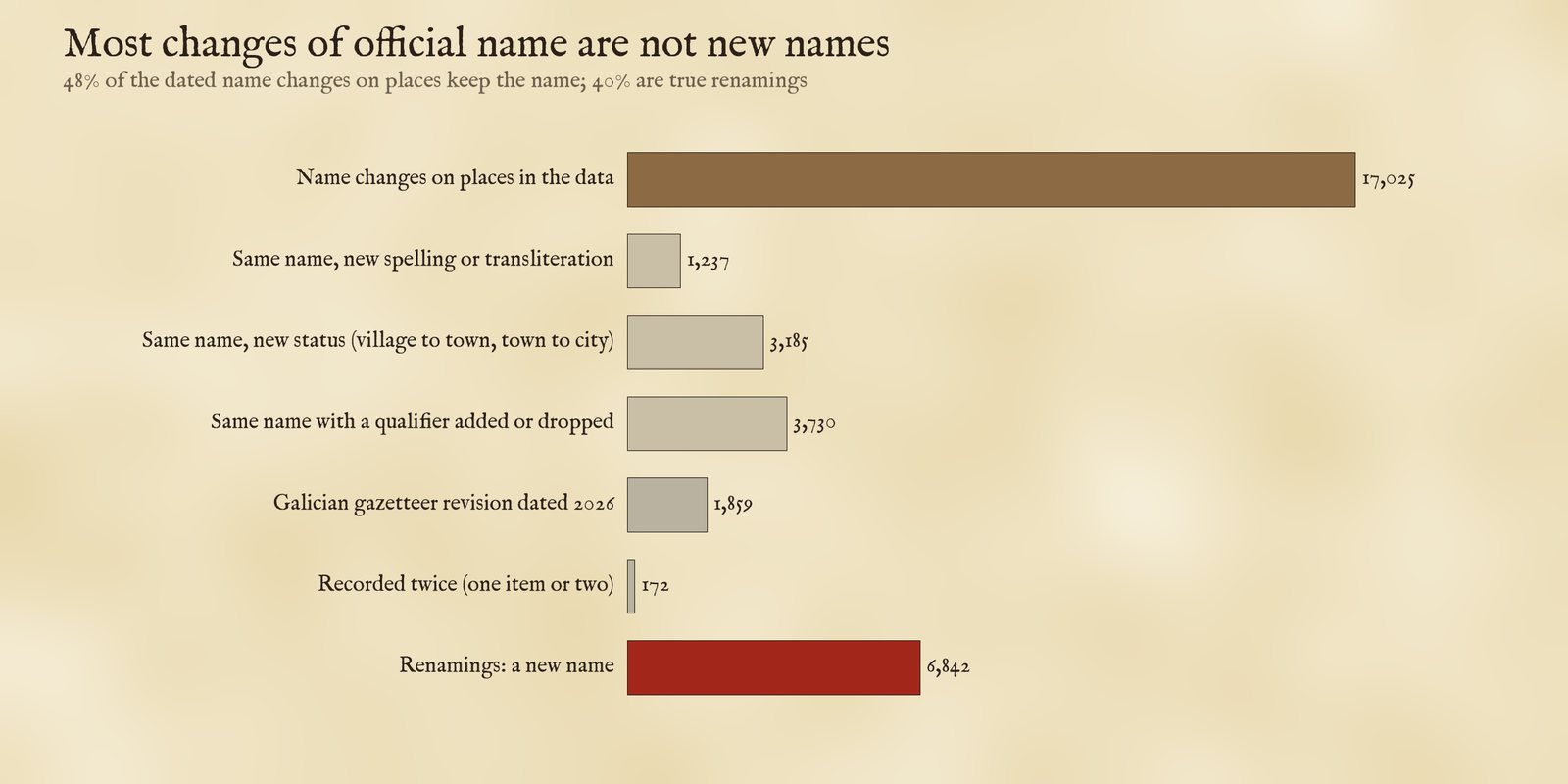
From the dated changes of official name in Wikidata to true renamings.
A name that simply ends, with no new name after it, is not a renaming either. 4,946 places have an official name with an end date and nothing to follow it, mostly villages and communes merged into a neighbour. I have left them out.
02 · The wavesRevolution, its undoing, and nation-building
I sorted every renaming into a wave by rules written down in advance (they are listed at the foot of the page): by country, by date and by the words in the old and new names. 2,852 renamings (42%) came under revolution and communism: names like Leningrad, Stalino, Kirovohrad and Karl-Marx-Stadt, and the many village renamings ordered under communist rule. 529 undid them. 890 belong to nation-building and language policy, 548 to mergers and administrative reform, 107 to war and new borders, and 22 to decolonisation. The other 1,894 (28%) fit none of these rules: local decisions, often in France and Japan, to honour a person, to sound better, or to tell two places apart.
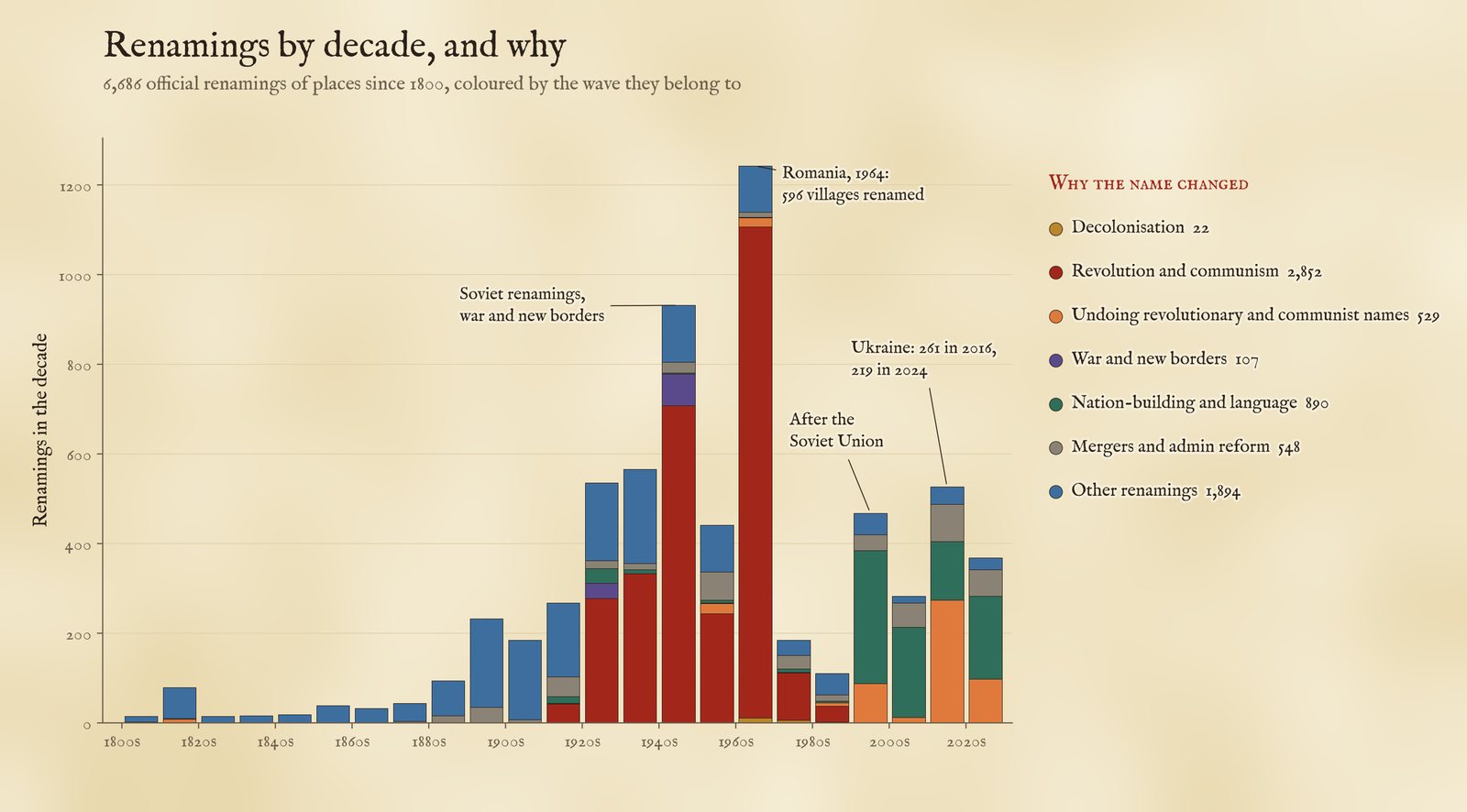
Renamings by decade since 1800, coloured by wave.
The busiest decade is the 1960s, and nearly half of it (48%) is one country in one year: in 1964, 596 Romanian villages got new names; some replaced names that sounded unflattering, as when Puturoasa (from the Romanian for stench) became Teiușu. The 1940s come next: Soviet renamings during and after the war, and the German names of the lands that became Polish and Russian in 1945. Ukraine dominates the recent decades. In 2016 alone, 261 Ukrainian places in the data lost communist names under the decommunisation laws, and in 2024 another 219 were renamed under a 2023 law against names tied to Russia; 91 of those still carried Soviet names.
03 · Name historiesRenamed, and renamed back
860 places were renamed more than once, and 158 three times or more. Vladikavkaz was Ordzhonikidze, then Dzaudzhikau, then Ordzhonikidze again, then Vladikavkaz. Luhansk was Voroshilovgrad twice. Rybinsk was named after one Soviet leader in 1946 and another in 1984, and got its old name back each time. The capital of Kazakhstan was renamed 6 times, as often as any place in the data: from Ak-Mola to Akmolinsk, then Tselinograd, Akmola, Astana, Nur-Sultan and Astana again.
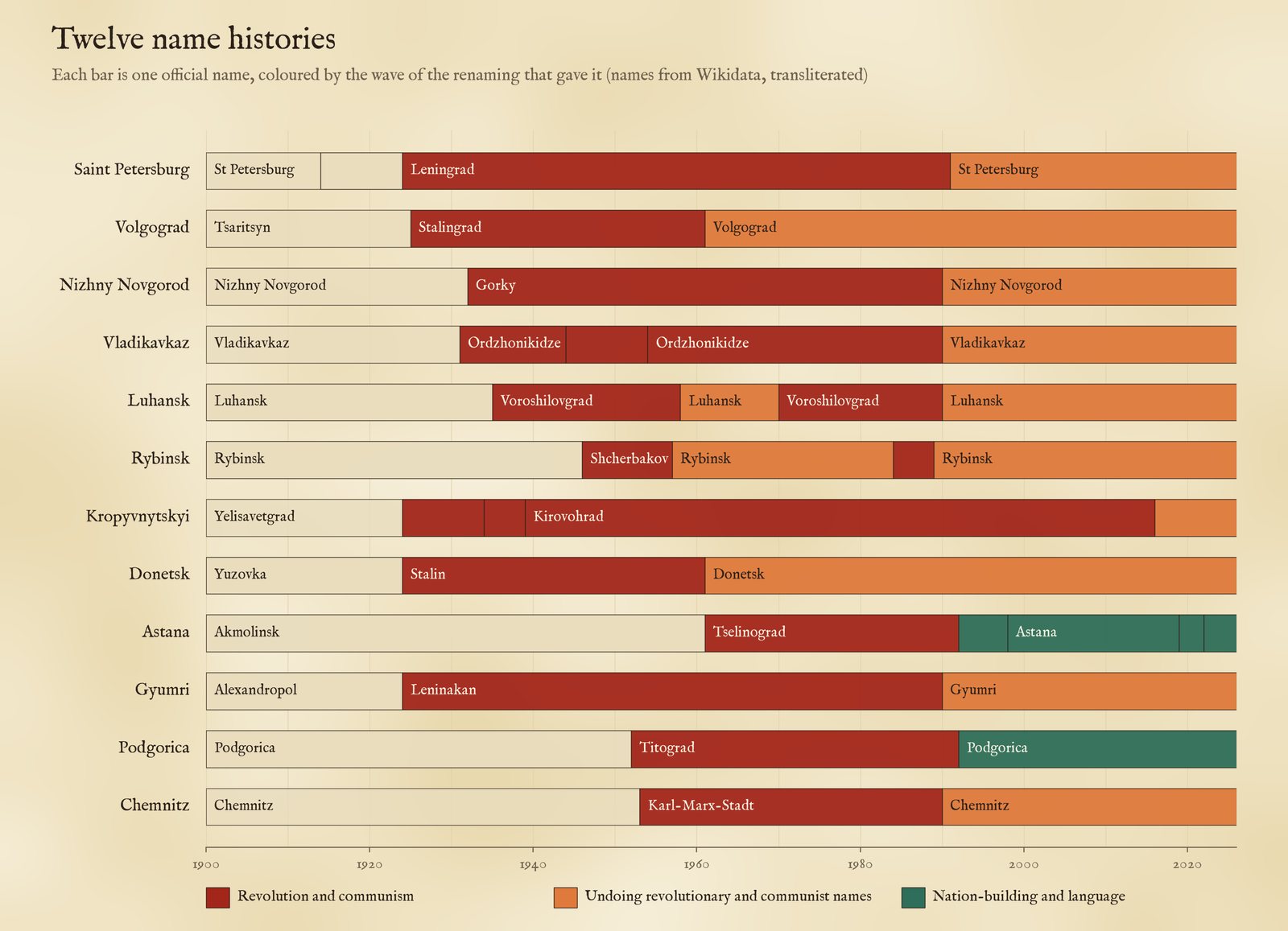
Twelve name histories since 1900. Names are transliterated from the Wikidata records.
In all, 303 places went back to a name they had held before. Most of the returns undo something: Leningrad to Saint Petersburg, Gorky to Nizhny Novgorod, Karl-Marx-Stadt to Chemnitz. The earliest examples are French. In 1793 the Revolution renamed towns too. In the data Lyon, punished for its revolt, becomes Commune-Affranchie and Bordeaux becomes Commune-Franklin; both later had their old names back, which Wikidata dates to 1814.
04 · WhereA record that leans east
47% of the renamings are in the former Soviet Union, and the five countries with most, Ukraine, Romania, Russia, France and Japan, hold 65% between them. That reflects how Wikidata was filled as much as how the world was renamed. Editors working from Soviet and Ukrainian gazetteers, the French official geographic code and Japanese municipal histories have recorded dated names in bulk. Africa, where independence brought some of the best-known renamings (Léopoldville to Kinshasa, Salisbury to Harare, Lourenço Marques to Maputo), has only 35 in the data, and the decolonisation wave only 22. That number is an artefact of the record, not a finding about history. Of twenty well-known renamings away from colonial names in Africa and Asia, 7 (Calcutta to Kolkata, Dacca to Dhaka and Bathurst to Banjul among them) have no dated official name in Wikidata at all, 2 more (Batavia to Jakarta, Usumbura to Bujumbura) have names but no dated change, and later ones such as Bombay to Mumbai and Madras to Chennai fall outside the 25 years after independence that my rule allows, so they count as nation-building. Only 7 of the twenty are in the decolonisation wave.
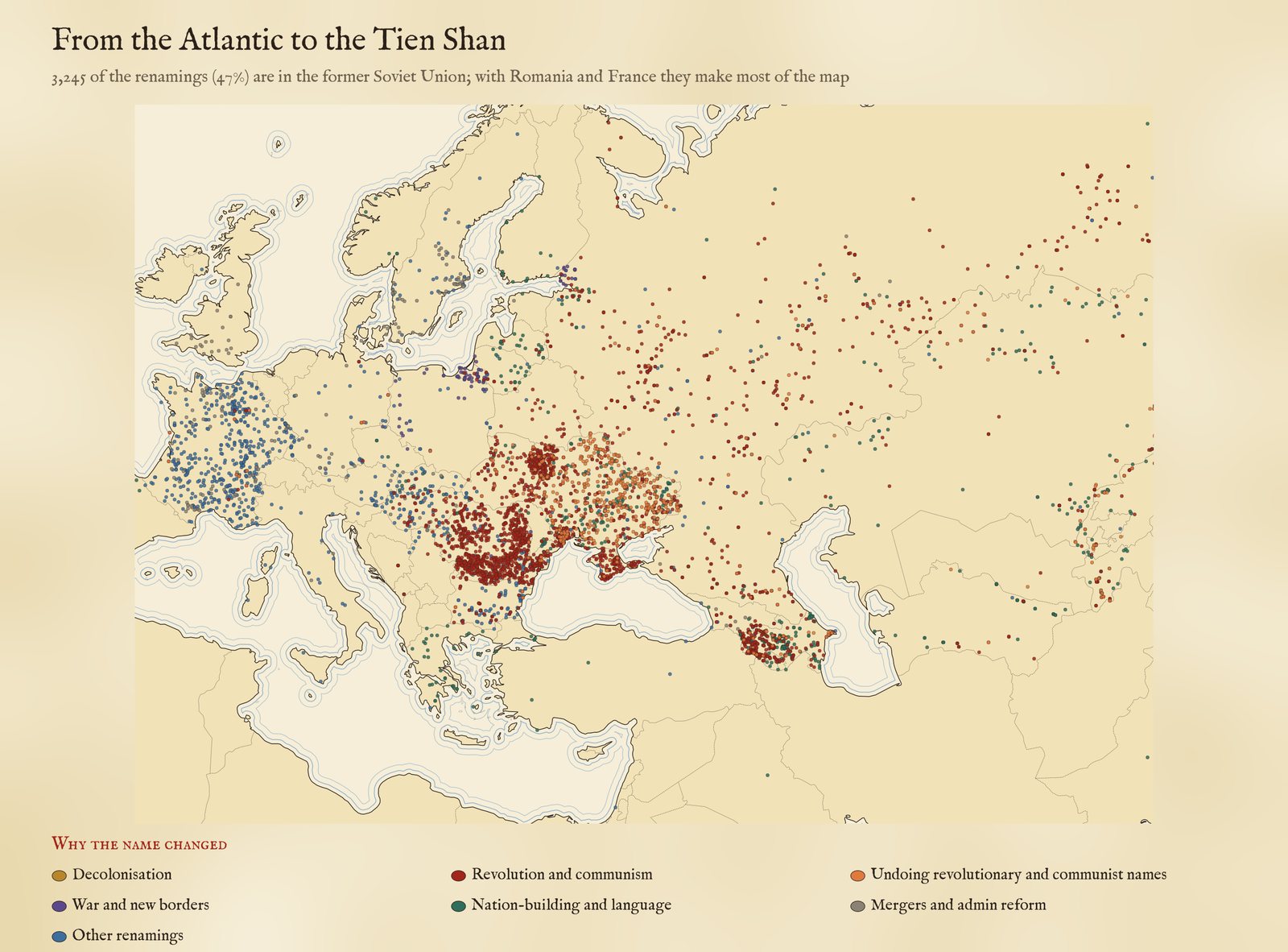
Renamings from the Atlantic to Central Asia, coloured by wave.
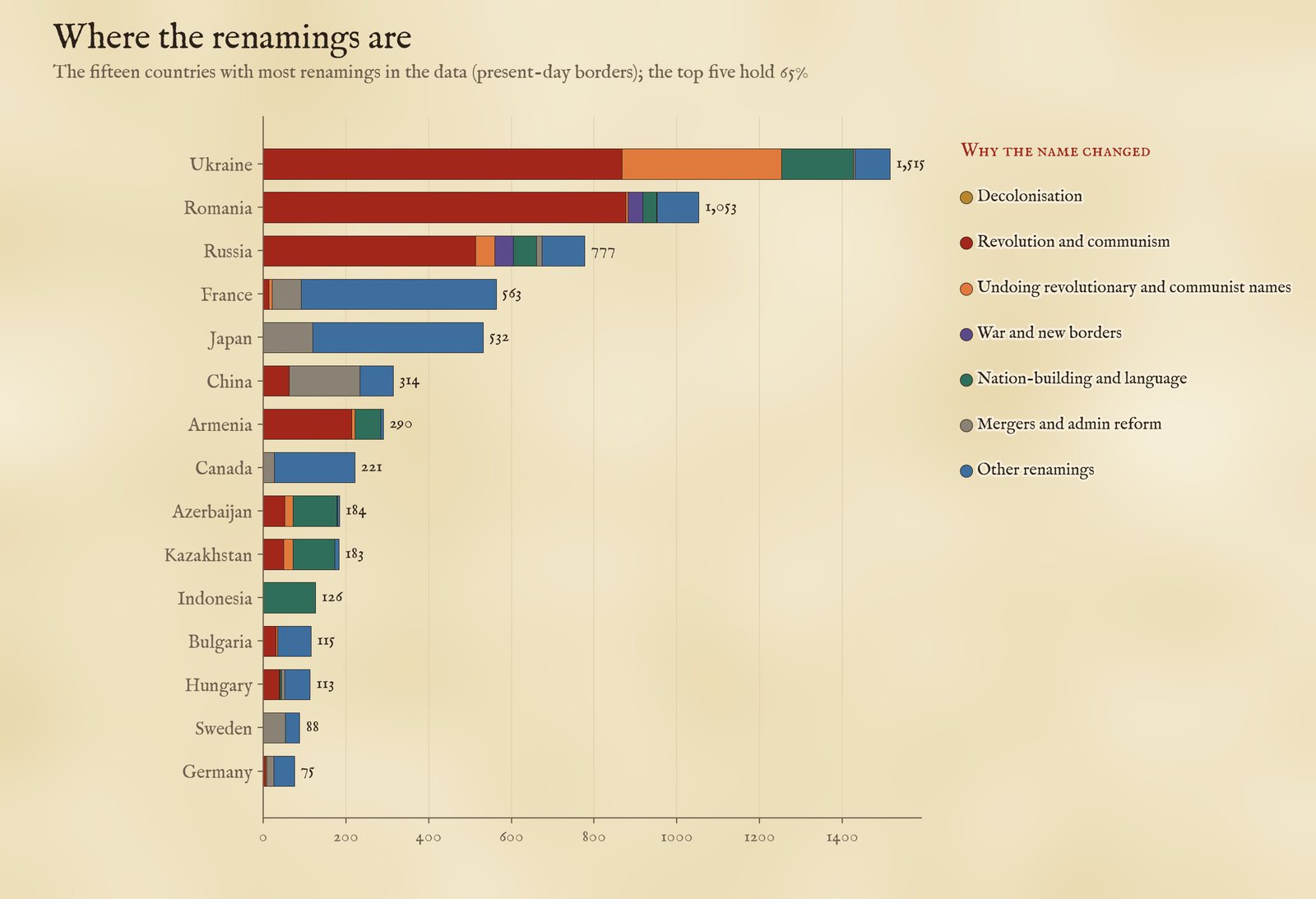
The countries with most renamings in the data, by present-day borders.
The United Kingdom and Ireland barely appear. The UK has 23 renamings in the data, almost all civil parishes and urban districts taking on a merged name, such as Lynton becoming Lynton and Lynmouth. Ireland has none: Kingstown's return to Dún Laoghaire and Queenstown's to Cobh, both in 1920, are not recorded with dates. Derry and Londonderry is a different matter again: two names in use at once, not a renaming, and so not something this method would count.
05 · How I did thisReading name histories
The data. Every Wikidata item with coordinates and at least one official name (property P1448) carrying a start or end date: 32,309 items and 79,554 distinct names. Each item is classed as a settlement, an administrative area, a street, a station, an institution or a natural feature from its Wikidata class. The present-day country of each place comes from where its point falls in the Natural Earth boundaries (Crimea counted with Ukraine).
Renamings. In one language at a time, a renaming is a name whose end date falls within a year of another name's start date. Changes recorded in several languages within a year are one renaming. Each is then tested: the same name respelled, given a new status word, or extended with a qualifier is set aside. Each remaining renaming is assigned to one wave by rules applied in a fixed order: undoing a communist or revolutionary name (an old name containing a communist leader, symbol or Soviet word, from 1953 on, and every Ukrainian renaming of 2015 to 2017, made under the decommunisation laws); a communist name given; war and new borders (Poland, Kaliningrad, Karelia, Sakhalin and similar, in the years after each war); any other renaming under communist rule (in western Ukraine and Belarus, Kaliningrad, Karelia and southern Sakhalin only from the year Soviet rule began there); municipal merger programmes (Japan, France, Belgium and others, in their years); decolonisation (from three years before to 25 years after independence); nation-building and language policy (for example Ireland after 1916, India after 1947, the former Soviet states after 1991); and other.
Checking. I read every renaming in the smaller waves (decolonisation, war, undoing), every place renamed three times or more, every place named in the text, and samples of every other group, and fixed the rules where they went wrong. Wikidata errors were the main problem: 170 renamings recorded twice (on one item, or on a village and its commune) and two one-off corrections. In all 11.9% of the name changes on places were removed as errors, duplicates or the Galician batch.
What this cannot say. Wikidata's coverage of dated official names is uneven, so the counts describe the record, not the world: the map would look different if Africa, India or the Americas were as well recorded as Ukraine. Dates are the dates in Wikidata, which sometimes mark a decree and sometimes its coming into force. The waves are my rules, not a historian's judgement of each case, and many renamings had more than one motive.
The most renamed places
Sources and licences
- Official names, dates, coordinates and classes: Wikidata (CC0), queried through QLever.
- Present-day countries: Natural Earth 1:10m admin 0 (public domain).
- Base map: The Inked World (MIT code, CC BY 4.0 text), drawn live from OpenStreetMap vector tiles served by OpenFreeMap (ODbL) and AWS Terrain Tiles. MapLibre GL JS 4.7.1 (BSD 3-Clause). Fonts: MedievalSharp and IM Fell (SIL Open Font License).
- Derived data (renamings.csv, places.json): CC0 like its source; text and figures CC BY 4.0; code MIT.