For 240 years, people accused of serious crimes in London were tried at the Old Bailey, and a printed account of almost every trial survives. The Old Bailey Online project transcribed and tagged all of them. I used its XML release to follow 197,581 trials from 1674 to 1913: what people were tried for, what happened to them, how many were women, and, for the years when the records say where an offence happened, where in London it was.
01 · PunishmentFrom the gallows to the prison
Before 1718, a guilty defendant at the Old Bailey faced death (35% of guilty verdicts in 1674 to 1717), branding, a fine or a whipping. Prison was almost never the sentence. The Transportation Act of 1718 changed that in a single year: in the decade after it, 67% of guilty defendants were sentenced to be shipped to the American colonies, and the share peaked at 72% in the 1760s. When the American war closed the colonies, transportation stopped dead (0% in 1777), prison took its place, and transportation sentences came back in the 1780s, with ships sailing to Australia from 1787. The last year with ten or more transportation sentences was 1857. Imprisonment has been the most common sentence in every decade since the 1830s, and by the 1900s it was 87% of all sentences.
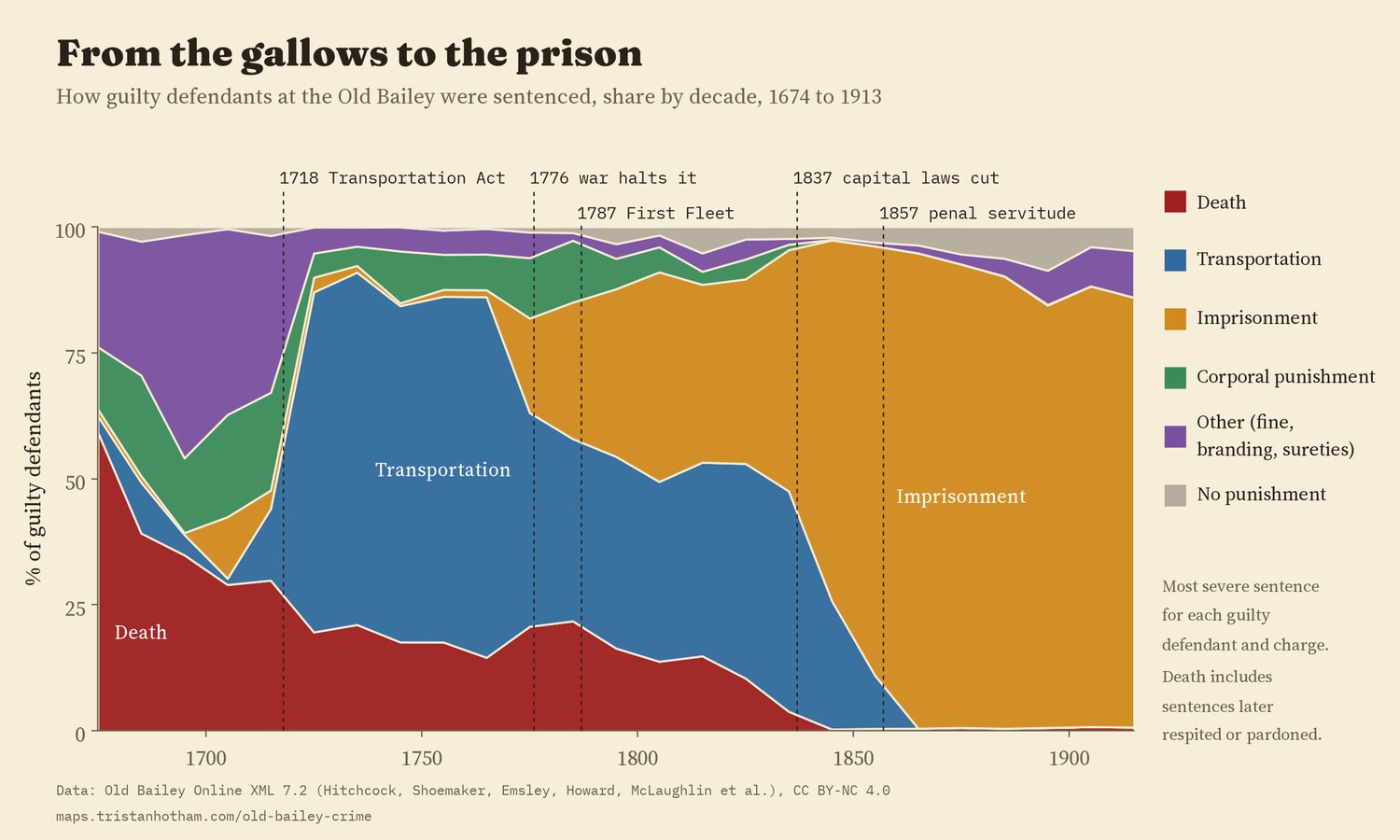
The most severe sentence for each guilty defendant, share by decade.
The death sentence is the surprise. Its share was highest at the very start, in the 1680s (39%), not at the supposed height of the Bloody Code. It rose again in the 1780s (22%), fell to 3.8% in the 1830s and to 0.3% in the 1840s, as Parliament cut the number of capital crimes step by step. After 1840, 78% of the few death sentences were for killing.
02 · WomenThe vanishing female defendant
In 1991 Malcolm Feeley and Deborah Little argued that women had been a large part of the criminal courts, sometimes more than 45% of those indicted at the Old Bailey in the eighteenth century, and then almost disappeared. The full XML release confirms it. Women were 36% of defendants in 1674 to 1717, 23% in 1775 to 1833 and 10% in 1868 to 1913. The fall is not about a change in which crimes came to court: among people tried for theft alone, women were 41% in 1700 to 1739 and 6% in 1880 to 1913. Nor is it the court's new, wider area after 1834: the share of women went up, not down, when the boundary changed.
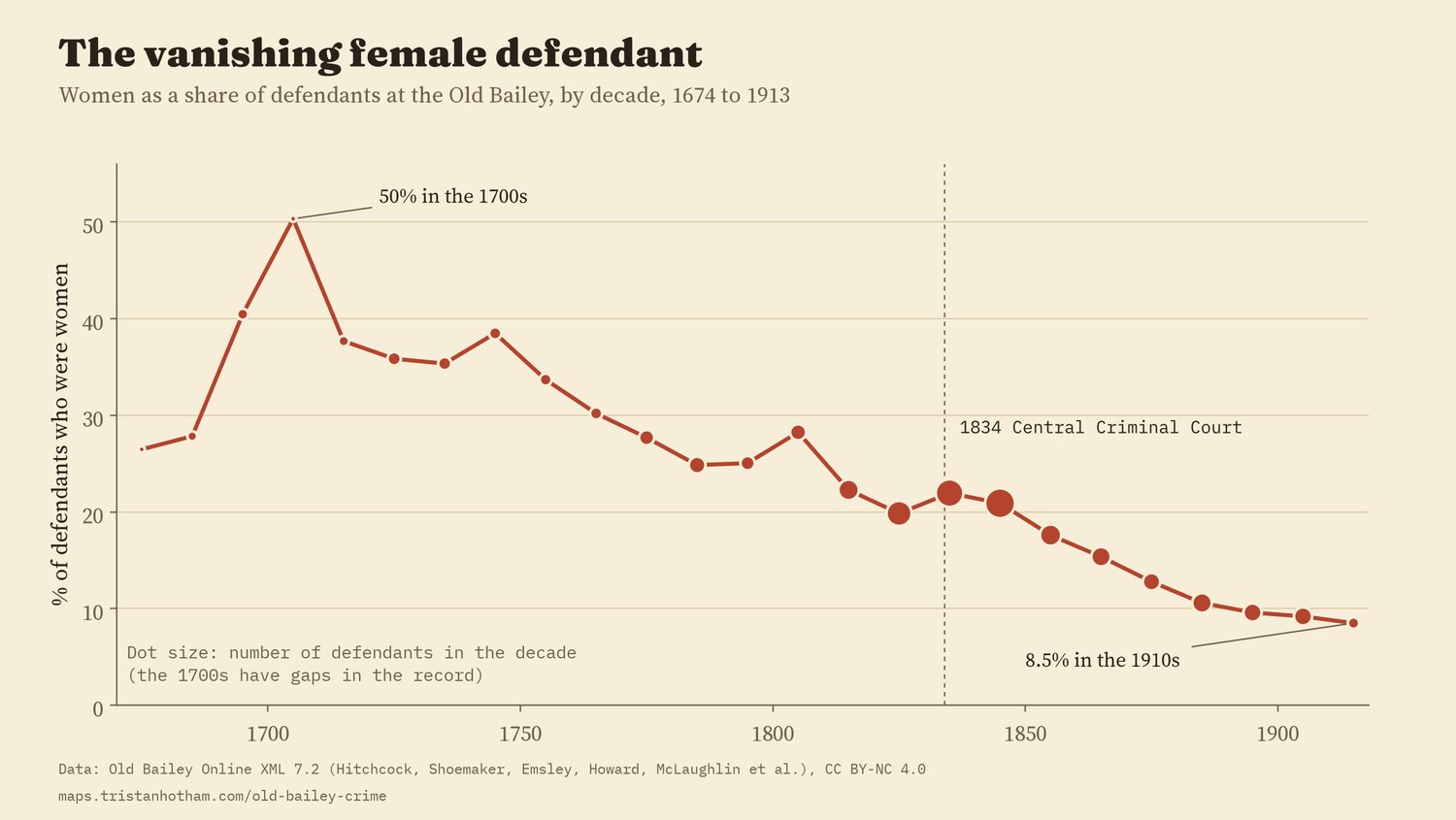
Women as a share of defendants, by decade.
03 · What came to courtFewer thefts, more violence
Theft was 72% of all offences. Violent offences (killing, robbery, sexual offences, assault and wounding) were 16% of violent and property offences in 1674 to 1717, only 7% in 1775 to 1833, and then 31% in 1868 to 1913, most likely as more small thefts went to magistrates instead. The rise was gradual: I found no clear jump at the Criminal Justice Act of 1855. Guilty pleas, rare in the eighteenth century, were 36% of outcomes after 1868.
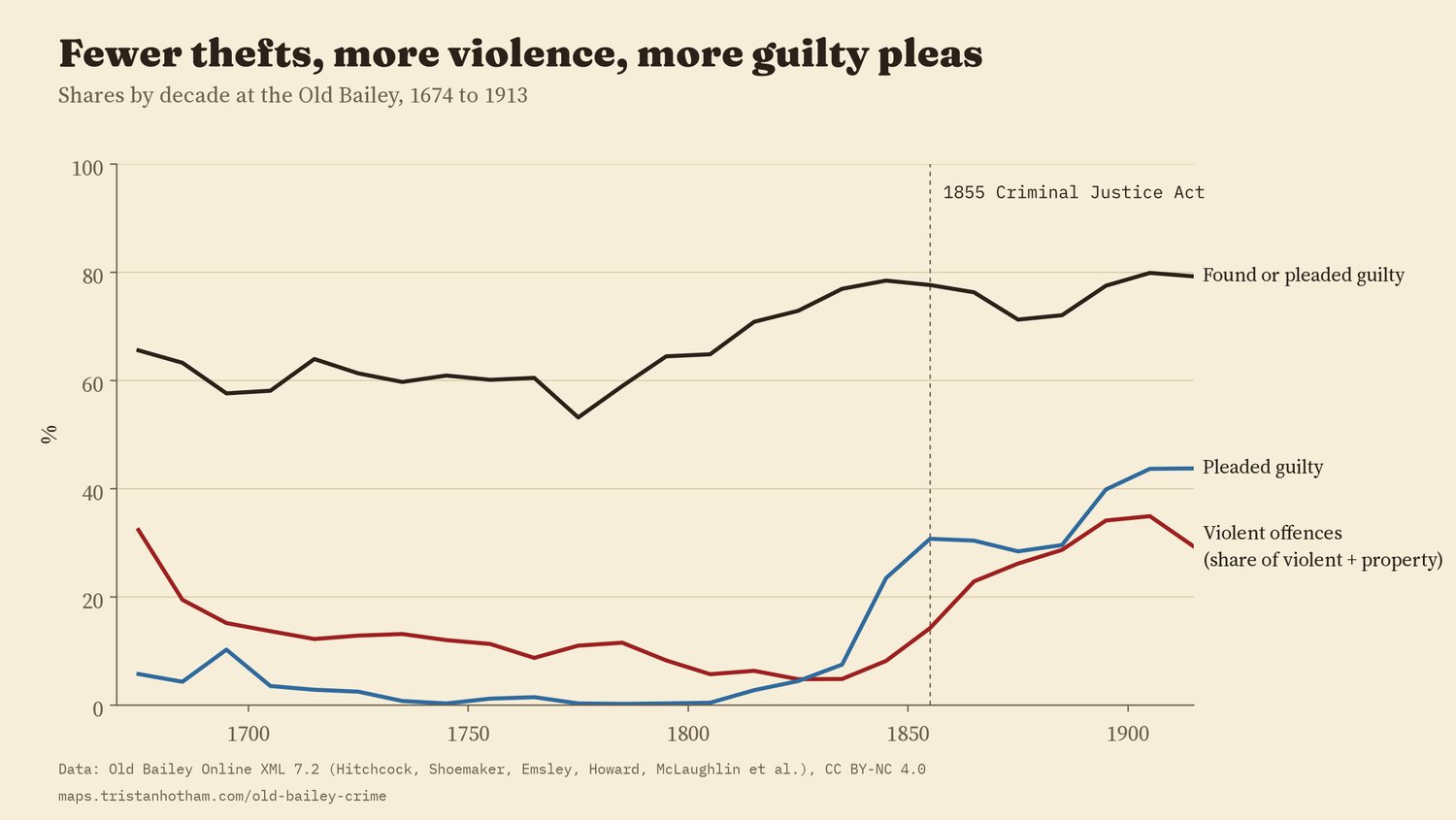
Shares by decade.
04 · WhereThe City's share shrank
From 1674 to 1834 the trial records tag the place where an offence happened. 55,987 offences have one, and my gazetteer placed 80% of them on a street or district. The City of London's share fell from 33% in 1674 to 1717 to 21% in 1775 to 1833, while Westminster, the northern parishes and the East End grew. This is a shift in thefts: leave thefts out and the rest show no clear trend. The busiest places were Holborn (864 offences), the Strand (837) and Whitechapel (818).
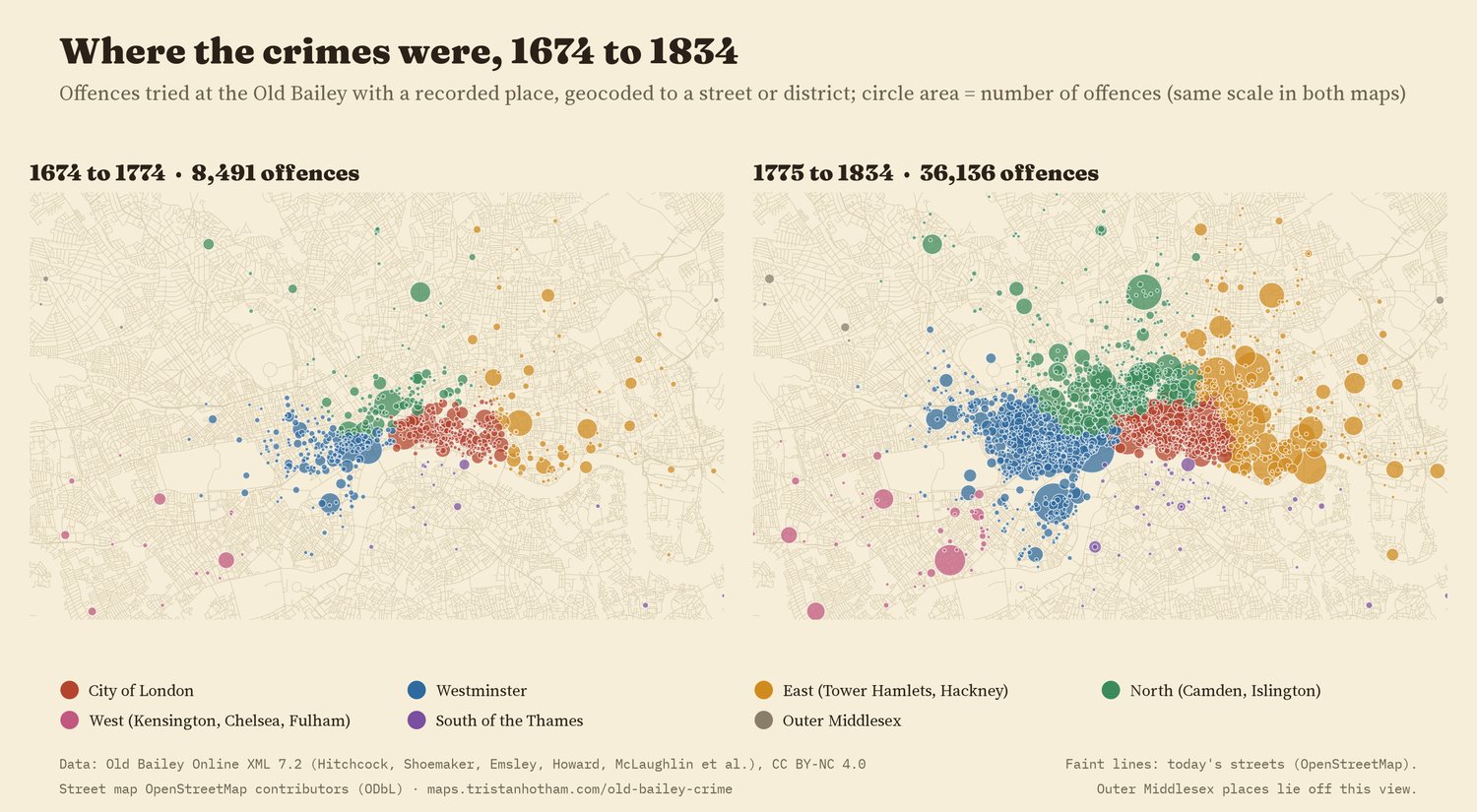
Geocoded offences, two periods. Circle area = offences.
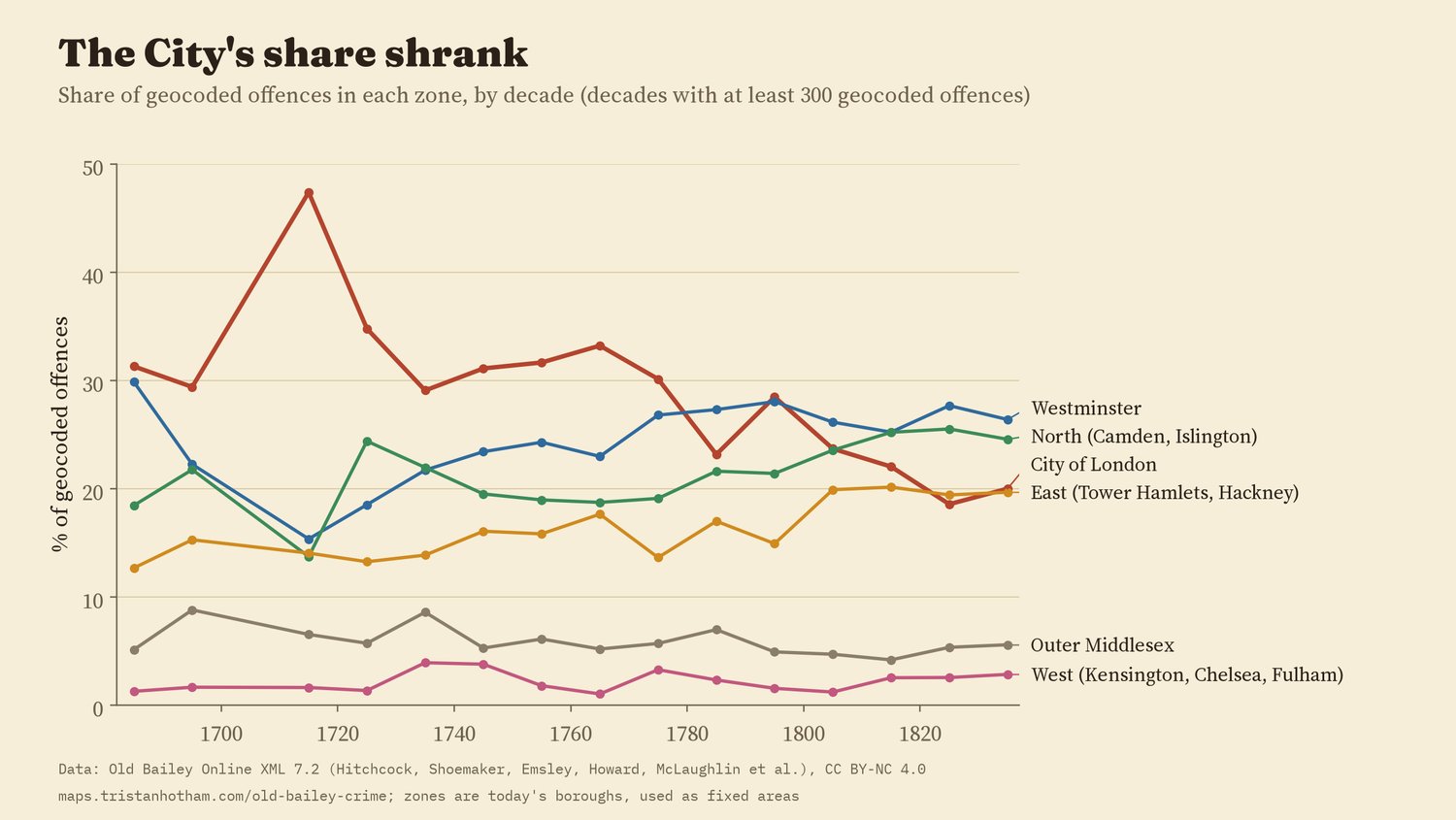
Share of geocoded offences in each zone.
05 · How I did thisTags, a gazetteer and a plan
The records. Old Bailey Online's XML marks every defendant, offence, verdict and sentence, and joins them up. I made one row per defendant per offence: 256,274 rows in 197,581 trials. A sentence is the most severe one recorded for that defendant in that trial. No names are kept.
The places. Trials up to October 1834 tag where an offence happened; later trials rarely do, so the map stops there. I matched those place texts to today's streets in OpenStreetMap, to districts in Wikidata, and to a hand-made list of 365 historic parishes, wards and renamed streets. Many streets have moved or vanished, so a point is approximate: a street's centre or a district's centre. District circles collect every offence that names only the district.
The plan. I wrote the hypotheses and tests down before computing any trend, and the paper reports them as planned, including the ones that did not come out as I expected.
What this cannot say. These are trials, not crimes. Who was prosecuted depended on victims, constables and magistrates, and the Old Bailey heard only serious cases. The places are where the record says, which is often the victim's house or shop.
Sources and licences
- Old Bailey Online XML data, version 7.2 (Old Bailey Proceedings Online 1674 to 1913; Tim Hitchcock, Robert Shoemaker, Clive Emsley, Sharon Howard, Jamie McLaughlin and others; University of Sheffield, doi:10.15131/shef.data.4775434), CC BY-NC 4.0. This work builds on Old Bailey Online, which is licensed under a Creative Commons Attribution-NonCommercial 4.0 International License.
- Streets: OpenStreetMap contributors (ODbL). Districts: Wikidata (CC0). Borough outlines: Office for National Statistics (Open Government Licence v3.0).
- Base map: OpenFreeMap Positron style (OpenStreetMap, ODbL). MapLibre GL JS 4.7.1 (BSD 3-Clause).
- Derived data CC BY-NC 4.0 (as the source requires); text and figures CC BY-NC 4.0; code MIT.