Ask voters what they want in an MP and "someone local" comes near the top of the list. Parties have noticed: since 2010 the share of MPs born near their seat has climbed to the highest level since records begin. But does being local actually win votes? I took every MP elected at a general election from 1832 to 2024, where they were born and how they did, and compared local MPs with other MPs who sat for the same seat, each measured against how their party did nationally.
01 · The bonusAbout one point in a hundred
The fairest comparison is within a seat: the same constituency, different MPs over the years, each set against how their own party did nationally at the time. On that comparison, an MP born within 25 km of the seat won 1.3 more points of the vote than MPs from elsewhere who sat for the same seat (95% confidence interval 0.7 to 1.8, across 14,580 MP returns in contested single-member seats). Comparing only MPs of the same party in the same seat gives 1.3 points, and MPs winning a seat for the first time show the same bonus (1.3), so it is not just incumbency. Put another way, roughly one extra vote in every 78 cast.
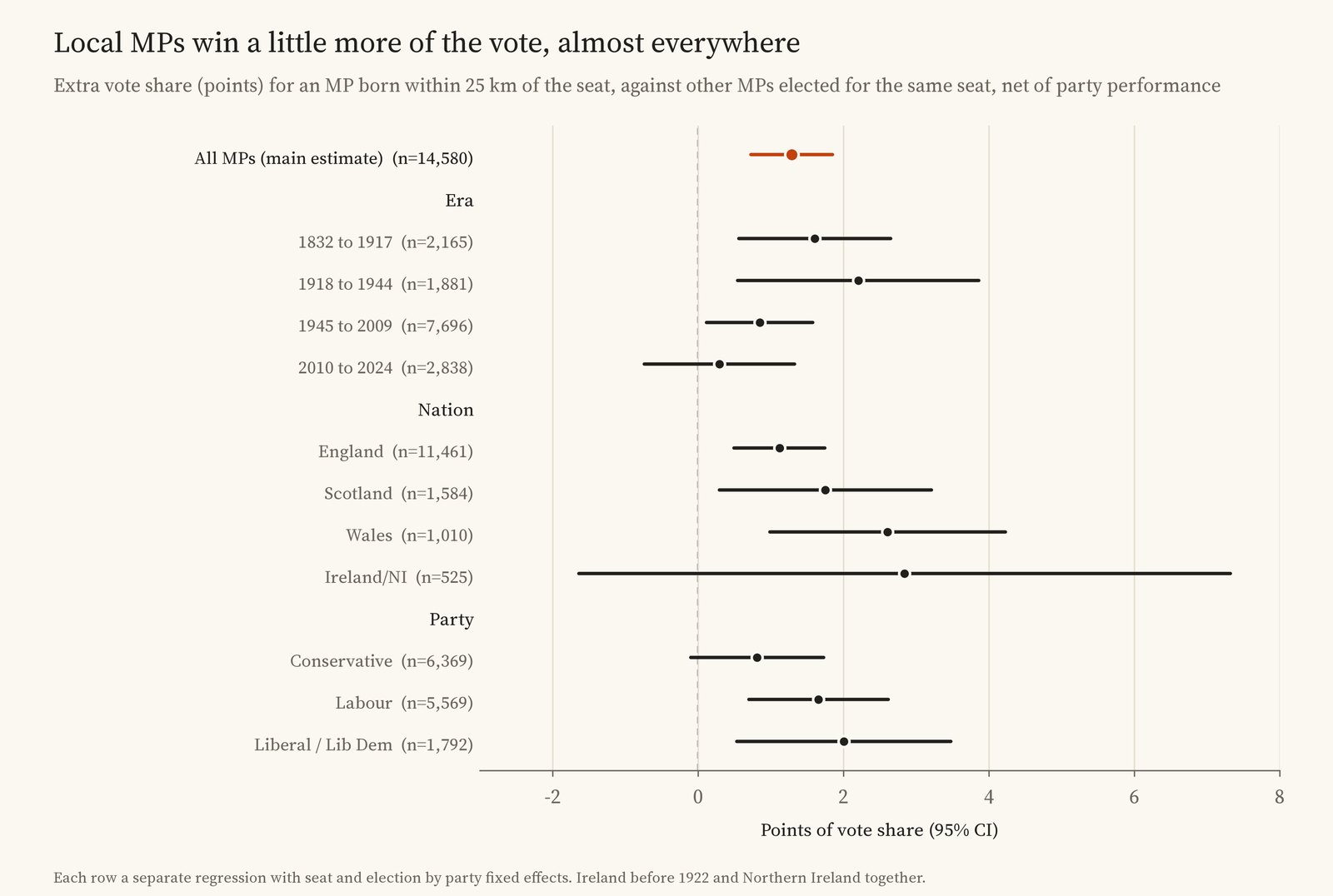
The local bonus by era, nation and party. Each line is a 95% confidence interval.
The bonus shows up in England, Scotland and Wales, for Labour and for the Liberals and Liberal Democrats; for the Conservatives it is smaller (0.8 points) and less certain. It holds when local means within 10 km (1.2) or within 50 km (1.0), when it means born in the seat's county (0.9), with only the most reliable birthplaces, and when each nation or era is left out in turn (between 1.1 and 2.1 points).
02 · But not at the countNo fewer defeats
A point of vote share is real but small. Most seats are won by far more: the median winning margin in contested single-member seats since 1832 is 17 points, and only 7.2% of contests since 1945 were closer than twice the bonus. So it is no surprise that local MPs who stood again were defeated just as often as anyone else: 14.6% against 14.5%, and +1.0 points once the party, election, nation and the MP's last result are taken into account (95% CI -0.3 to +2.3). Local MPs did not serve longer either: 3.0 general elections on average against 3.2.
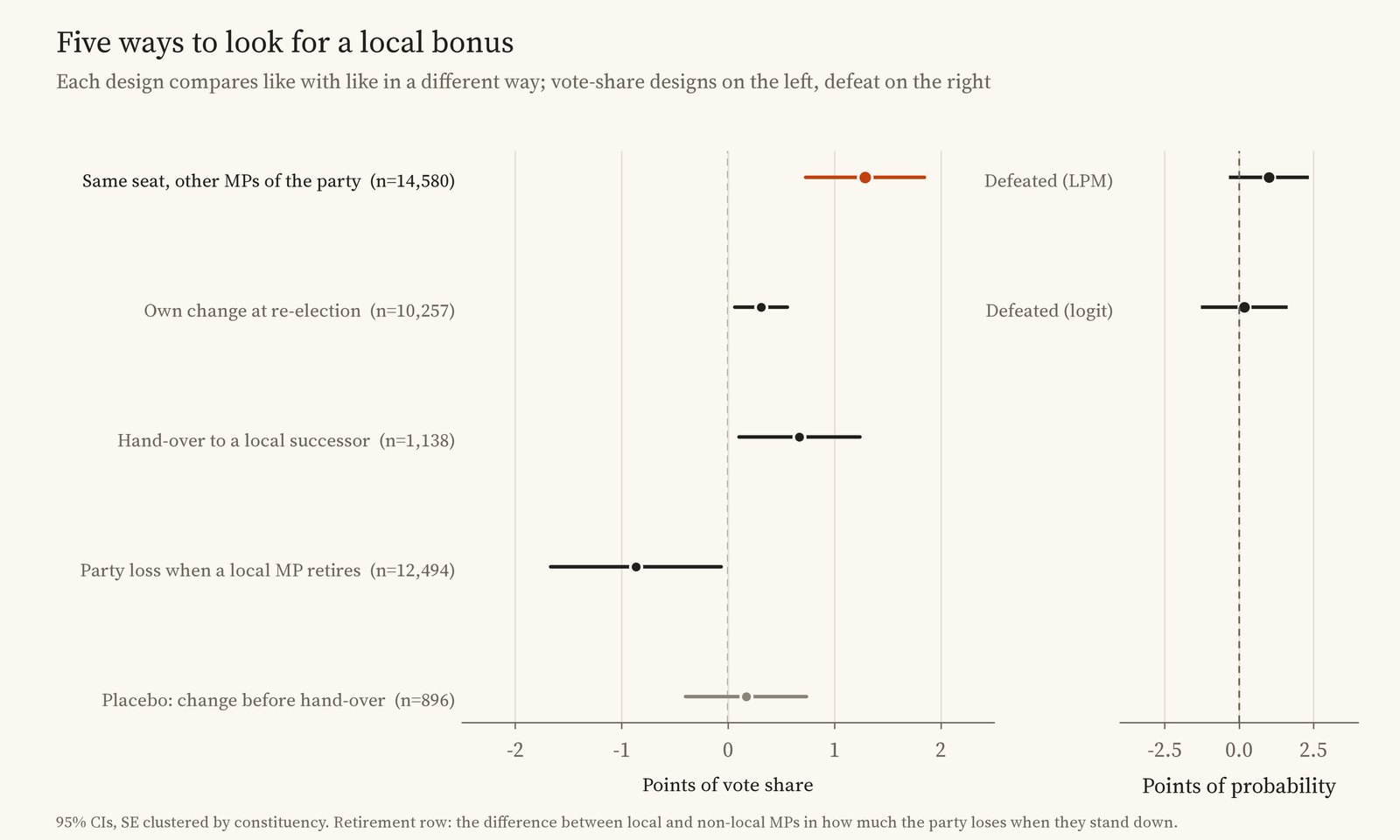
Five designs. The vote-share designs point the same way; defeat does not move.
Three other comparisons point the same way as the first. Local MPs did slightly better at re-election than non-local ones (+0.3 points of change, CI 0.1 to 0.6). When a seat passed from one MP of a party to another, the party did better when the newcomer was local and the old MP was not (+0.7 points per step, CI 0.1 to 1.2), and the newcomer's roots did not predict the party's change in the election before they arrived, which is reassuring. And when a local MP stood down, the party lost 0.9 points more than when a non-local MP did (CI -1.7 to -0.1), as if part of the vote had been personal.
03 · Through timeMore local MPs, no bigger bonus
The striking thing about recent Parliaments is how local they have become: 26% of MPs elected in 2005 were born within 25 km of their seat, and 43% in 2024. If parties chose local candidates because it wins votes, you might expect the bonus to be at its largest now. It is not. Since 2010 the estimated bonus is 0.3 points, with a confidence interval from -0.7 to 1.3 that includes zero; it was larger before 1945. A direct test (not in the original plan) puts the recent bonus 1.3 points below the earlier one, with an interval that only just excludes zero: a decline is possible, not proven.
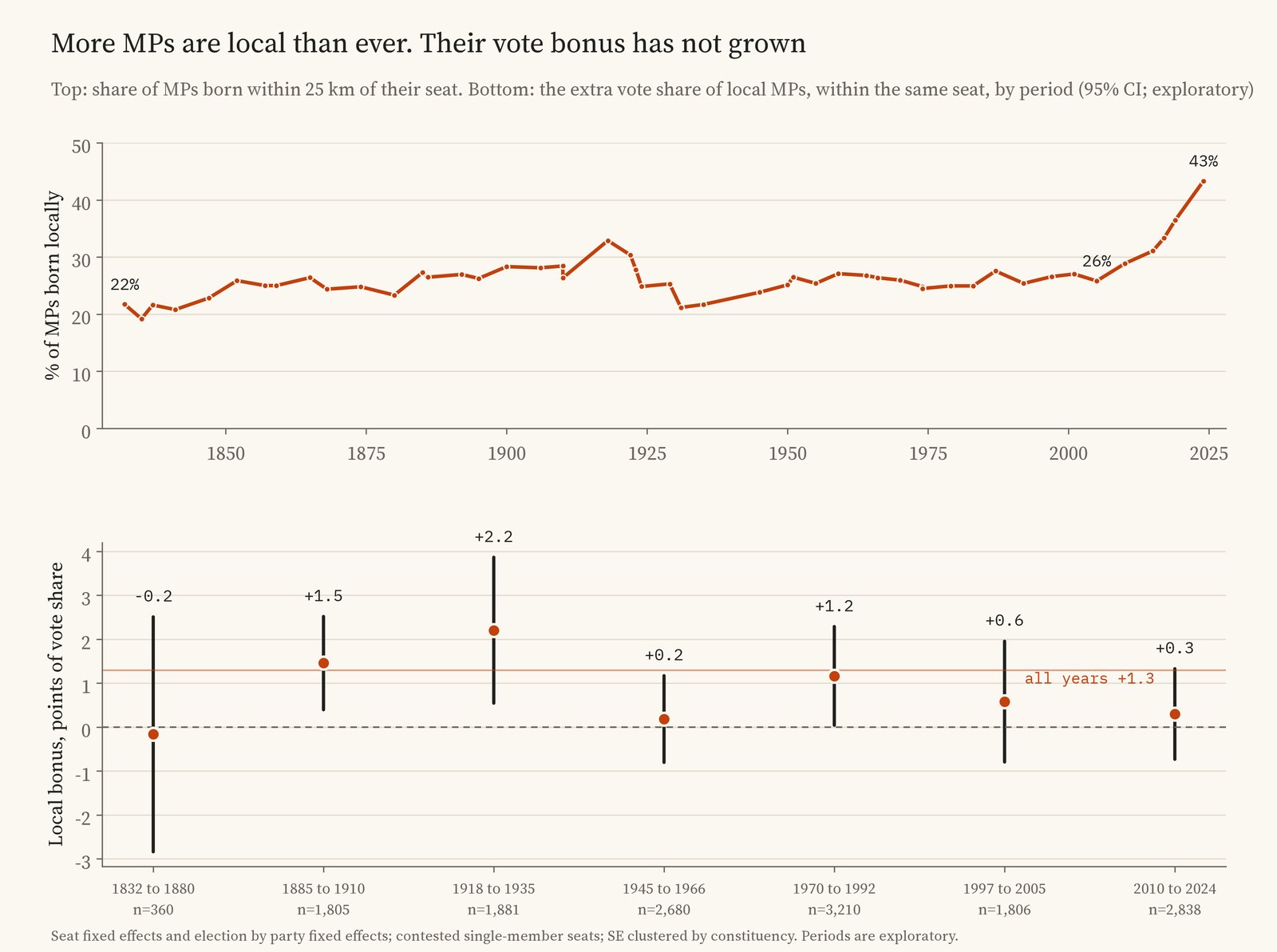
Top: MPs born within 25 km of their seat. Bottom: the local bonus by period (exploratory splits).
One reason may be that when nearly half of MPs are local, being local no longer marks anyone out; another is that the measure is noisier for recent intakes, many of them first elected in 2019 or 2024 and not yet tested at a second election.
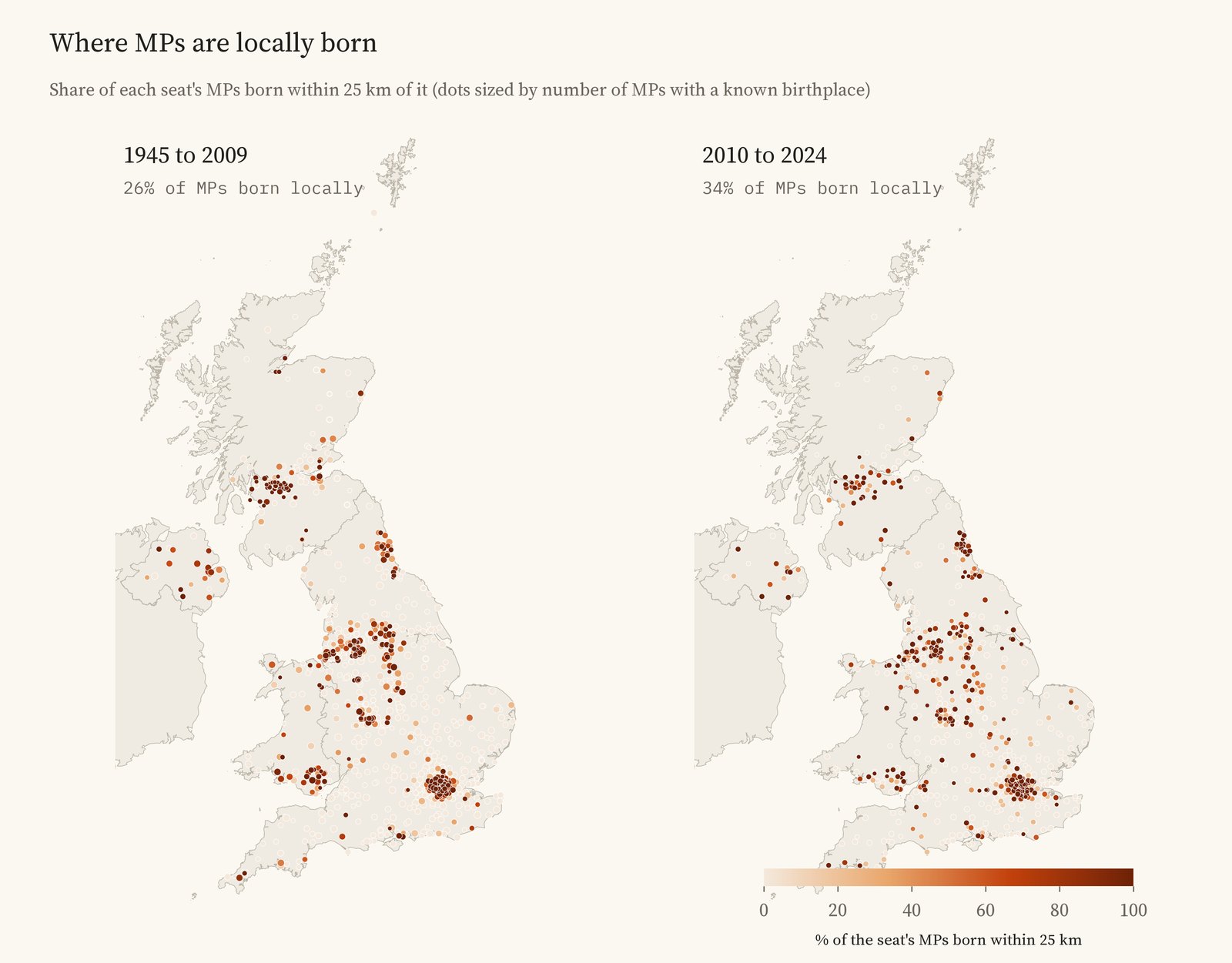
Share of each seat's MPs born within 25 km, before and since 2010.
04 · How sureChecks and placebos
I wrote down the tests before running them, with what would count against a local bonus, and report the planned ones first. The main estimate barely moves with different fixed effects, ways of clustering the uncertainty, or definitions of local (0.9 to 1.5 points). Two placebos behave as they should. Shuffling who is local within each party and election gives estimates centred on 0.01; none of 500 shuffles came near the real one. Being born near a different, randomly chosen seat adds 0.27 points on its own, because random seats are sometimes next door, and little once real localness is in the model (a version added after a first run): 0.20 points on average, with the middle 95% of draws from -0.14 to 0.63.
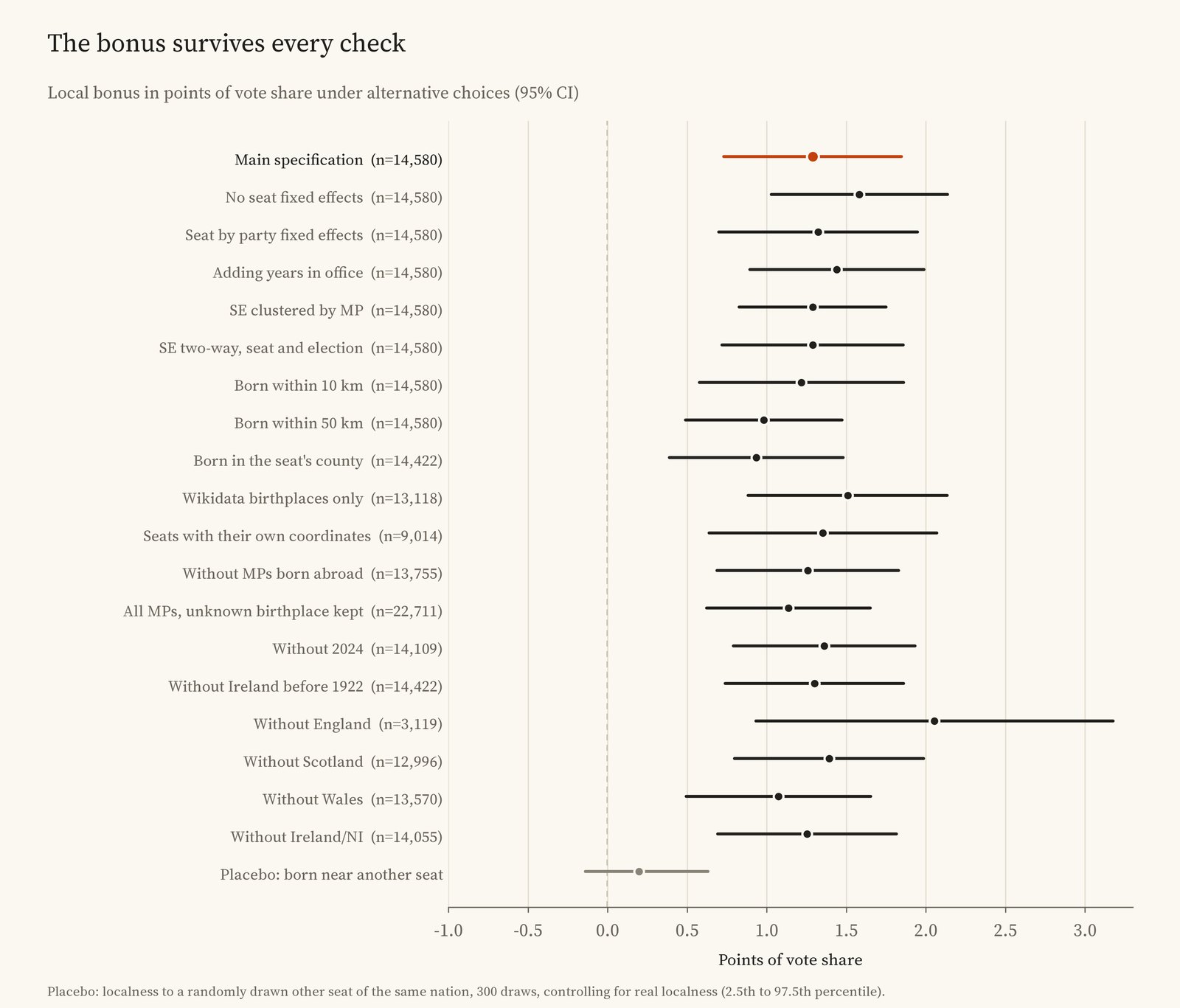
The bonus under alternative choices, with a placebo at the bottom.
05 · How I did thisBirthplaces, seats and like with like
The MPs. From my earlier study Born and bred?, every MP returned at a general election from 1832 to 2024: 31,737 returns of 10,094 people, with the distance from birthplace to seat for 57% of returns. I linked each to its own result in Who won here? by constituency, election and surname (99.6% linked), and followed each MP to the next general election in the same seat: stood and won, stood and lost, or did not stand.
The comparison. The main model compares MPs within the same seat, net of everything that moved their party nationally at each election (seat fixed effects and election by party fixed effects), with uncertainty clustered by constituency. University seats and the Speaker are left out. Losing candidates have no birthplace unless they were an MP at some point, so the designs start from MPs.
What this cannot say. Birthplace stands in for roots: someone born in a nearby hospital town counts as local, someone who moved there at two does not. Seats are points, not boundaries, and boundaries changed. Birthplaces are known for fewer MPs before 1900, mostly the better known. All the designs start from people who won at least once, so this is about MPs, not every candidate. And this is observational: a local MP may also be a sign of a strong local party, which would itself win votes. The within-seat, hand-over and retirement designs reduce that worry, but do not remove it.
Sources and licences
- MPs and birthplaces: Hotham (2026) Born and bred?, from Wikidata (CC0) and English Wikipedia (CC BY-SA 4.0).
- Results: Hotham (2026) Who won here?, from UK Parliament and House of Commons Library results (Open Parliament Licence v3.0).
- Base map: OpenFreeMap Positron, OpenStreetMap contributors (ODbL). MapLibre GL JS 4.7.1.
- Data CC BY-SA 4.0 (because some birthplaces come from Wikipedia); text and figures CC BY 4.0; code MIT. Contains Parliamentary information licensed under the Open Parliament Licence v3.0.