This study is about attention, not about the people themselves. A Wikipedia article being read more or less says nothing about the worth of a life. But the pattern across thousands of lives says something about how a culture remembers: how quickly a death becomes news, and how quickly the news becomes the past.
01 · The spikeA month of looking up
In the month someone dies, the typical person's article is read 14.9 times as much as it was in the year before, as a share of all English Wikipedia reading. Taking the higher of that month and the next (for deaths late in a month), the median peak is 16.5 times the usual level, and a quarter of people see more than 39 times. Then it falls away fast. The month after the death the median is 2.77, by the second month 1.44, and a year on 1.07, with a small bump at the first anniversary.
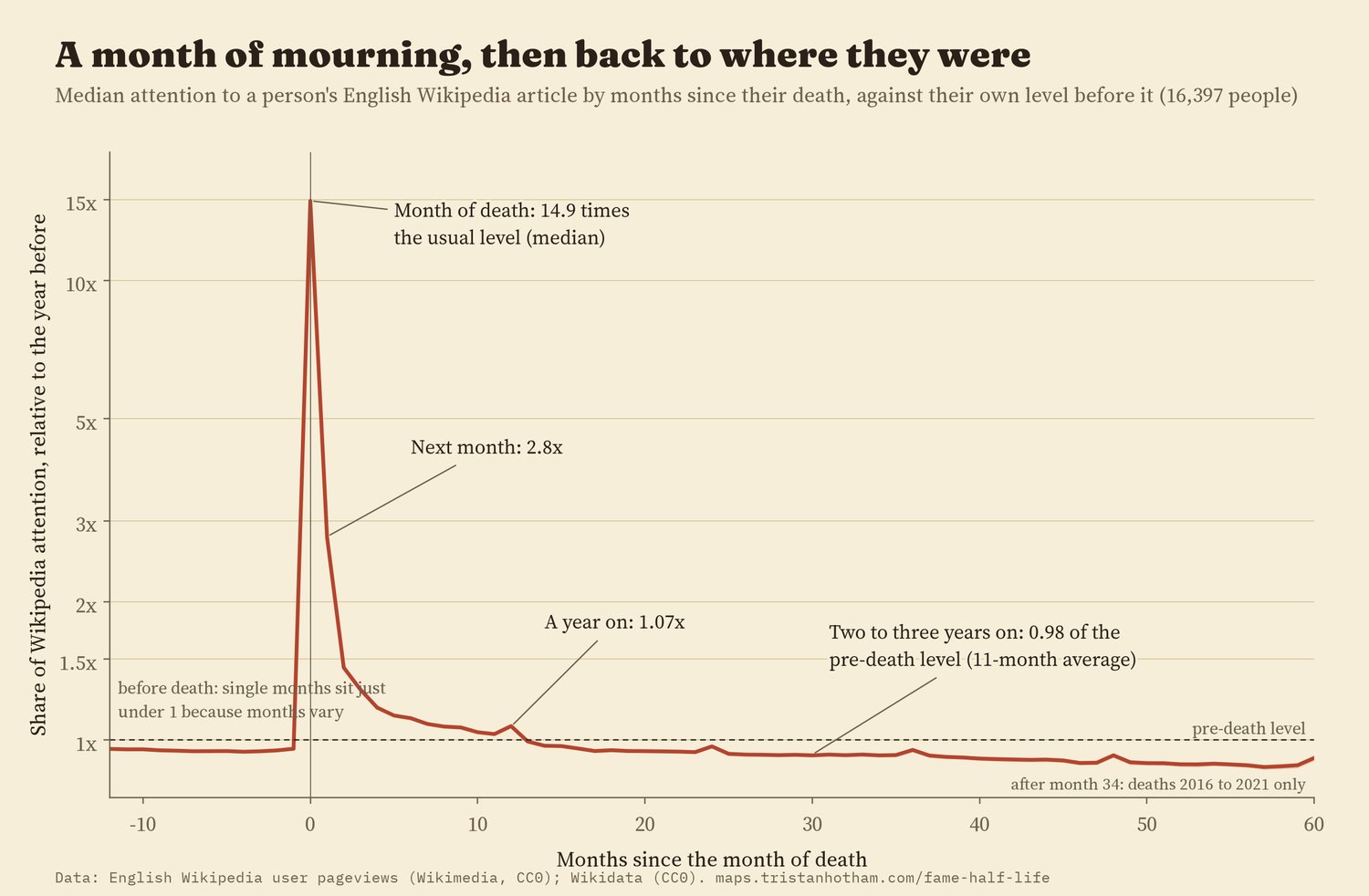
Median across 16,397 people, with a 95% interval.
02 · Two speedsFast, then slow
The fall has two speeds. A model with two decaying parts fits the curve more closely than a single exponential or a power law: the first rush has a half-life of about 11 days, and the remaining extra attention fades with a half-life of about 6.9 months. This loosely echoes the idea, from studies of collective memory, of a short burst of news and conversation followed by a slower settling, though what is measured here is looking up, not memory. A power law, the other common shape for forgetting, predicted later deaths slightly better when fitted on earlier ones, so the two-part model is the better description rather than a proven law.
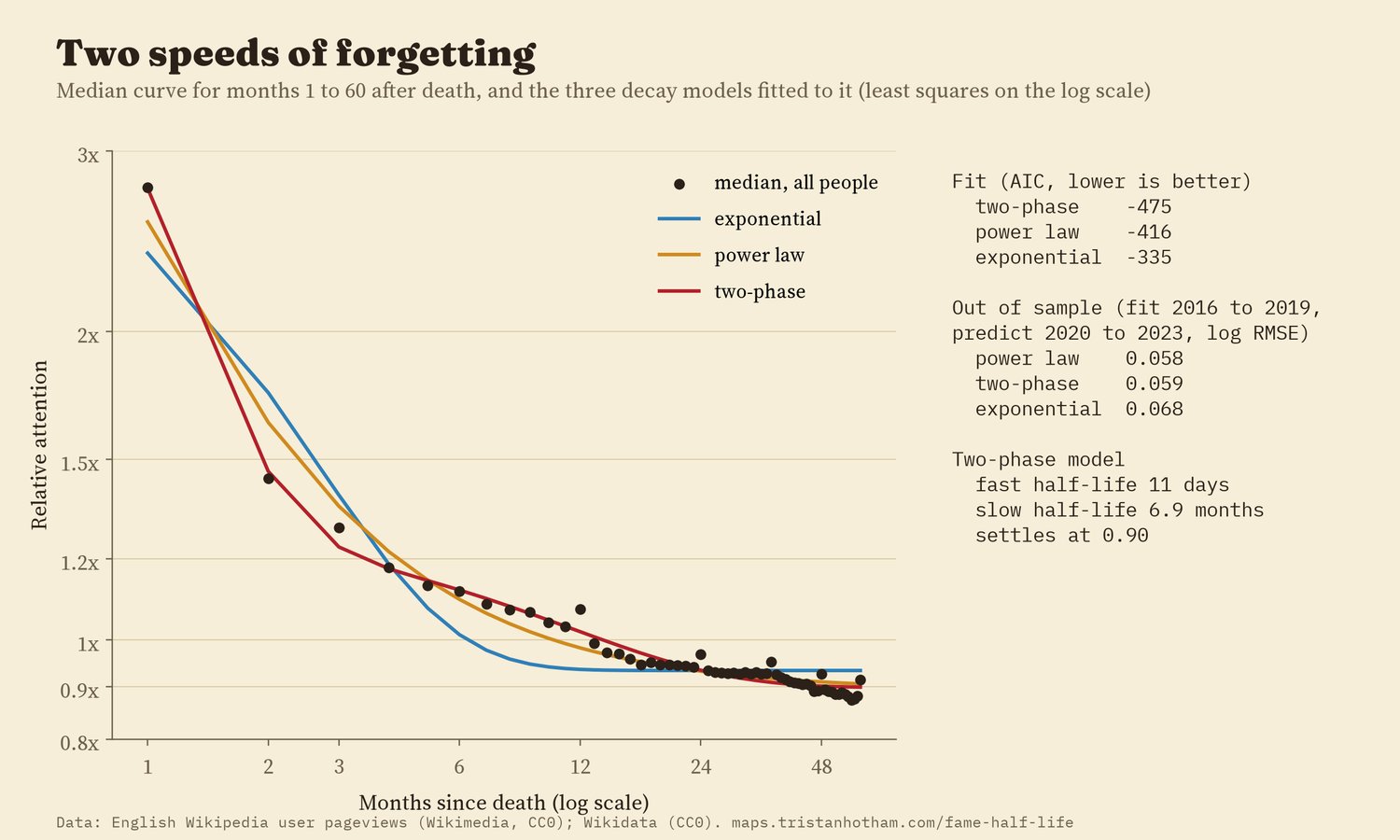
Three decay models fitted to the median curve.
03 · The settling pointBack to where they were
Two to three years after a death, the typical article gets 0.98 of its pre-death share of attention (95% interval 0.97 to 0.99). Death does not, on average, make someone more looked up in the long run. 48% of people end above their old level and the rest below. One way to judge this is against people who had not died yet: two years before each death, attention to the same articles was drifting down by about 3% a year. A second check, exploratory and added after the plan, looks at how attention changed over the two to three years before each death: it fell by about 5%. Measured against that drift, people end about 5% above where they would otherwise have been (95% interval 3% to 6%), assuming the old drift would have continued.
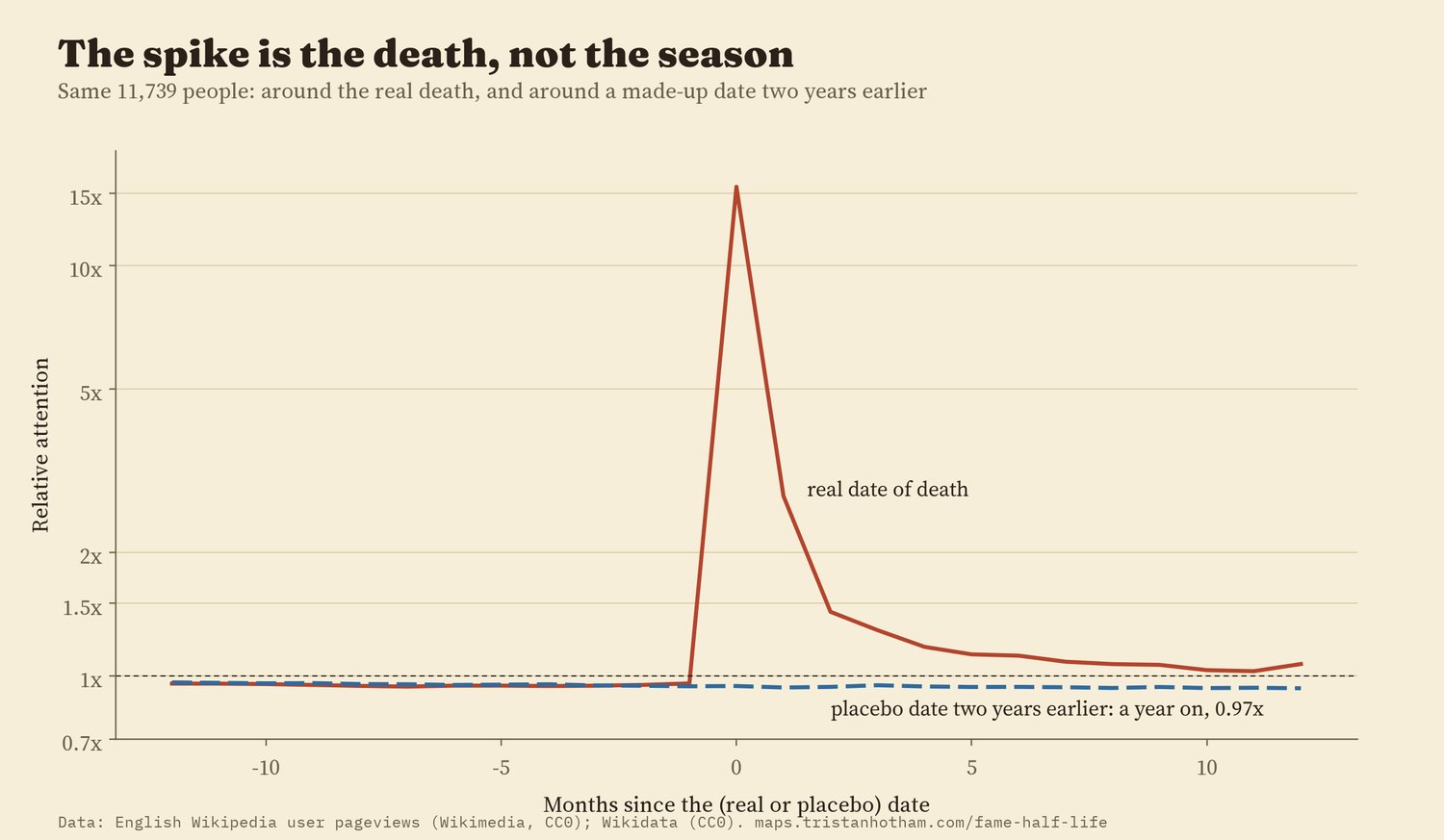
A placebo test: the same people around a made-up date two years before their death.
04 · Who keeps the attentionYoung deaths, and performers
The clearest difference is age. People who died under 50 had a median peak of 99 times their usual attention, and two to three years later still had 1.47 times it. People who died at 90 or over peaked at 12 times and settled at 0.89. In a model that also allows for occupation, citizenship, sex, fame before death and the year of death, dying under 50 goes with 63% more lasting attention than dying at 65 to 79 (95% interval 51% to 77%), and this holds in all 21 planned checks. It does not show up at a made-up date before the death, so it is not just that younger people's articles were already rising.
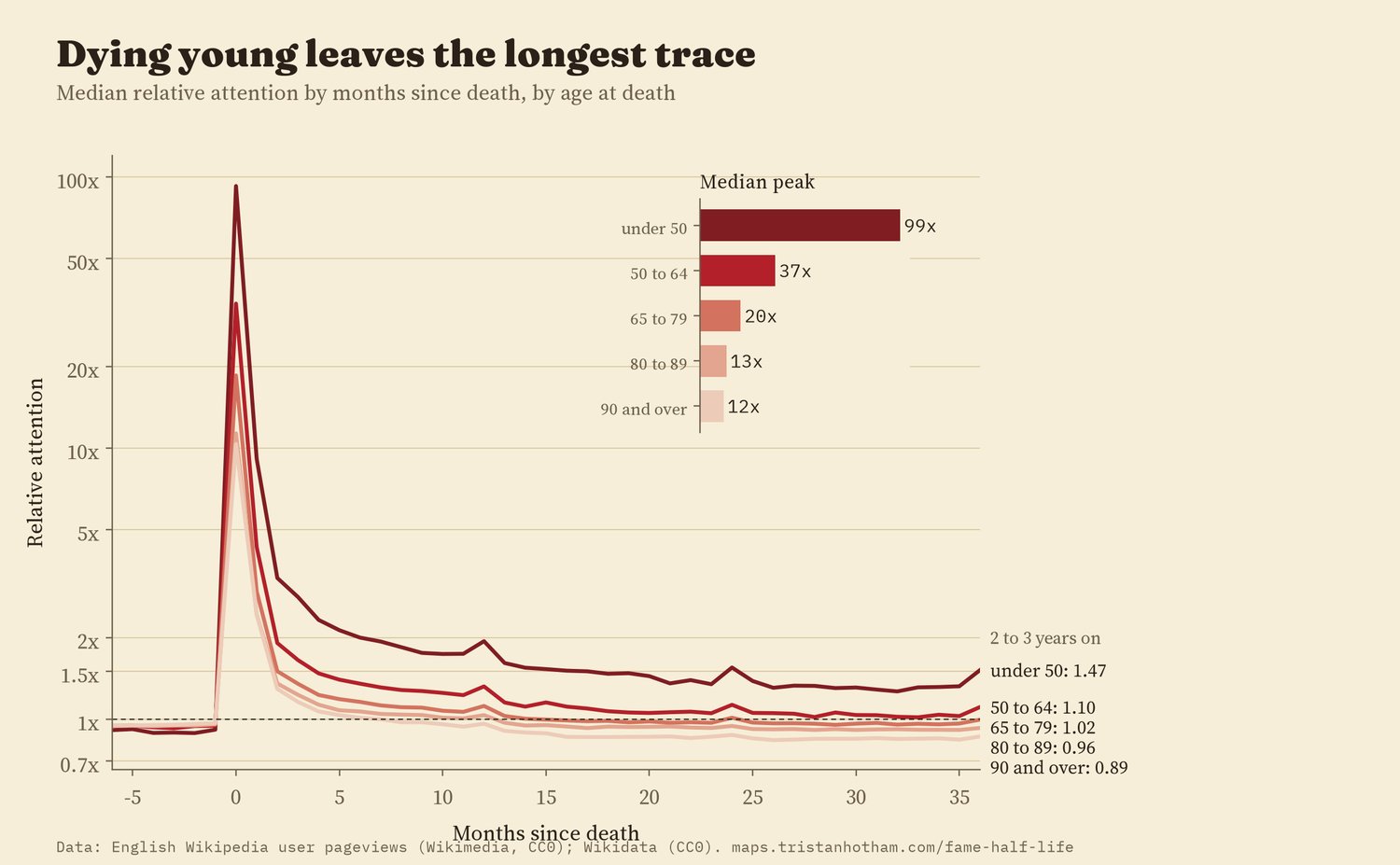
Median attention by age at death.
Among occupations, performers (actors, musicians, singers, directors) are the only group whose typical attention ends above where it started (1.10). Religious figures settle lowest (0.83). In the model every other group keeps less than performers, sport by 31% and politics and law by 24%. Part of these gaps was there before the deaths, though: at the made-up earlier date, sportspeople's and scientists' articles were already fading faster. Journalists and religious figures get unusually large spikes, scientists small ones.
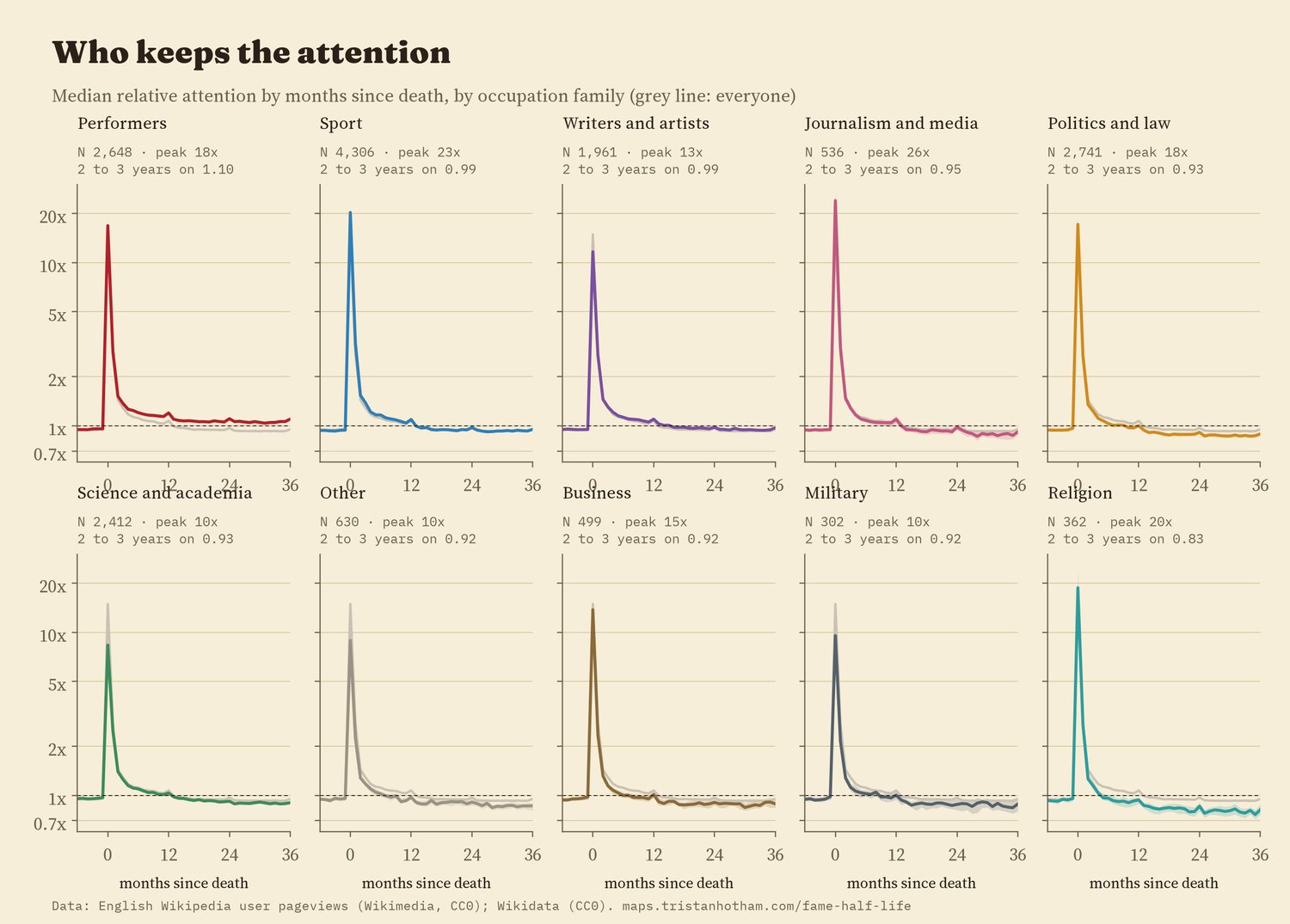
Median attention by occupation family (one sampled occupation per person).
Women and men are hard to tell apart. The typical woman settles at 1.02 and the typical man at 0.97; in the model women come out 3% lower, but that difference disappears in most of the checks, so I would not read anything into it. Citizens of English-speaking countries have smaller typical spikes on English Wikipedia (13.9 times against 21.4), perhaps because more readers already know them. Comparing people with the same attention before death, they keep more of it later (+23%), but without that comparison the difference disappears and in a median regression it is only 6%, so this one is not robust either.
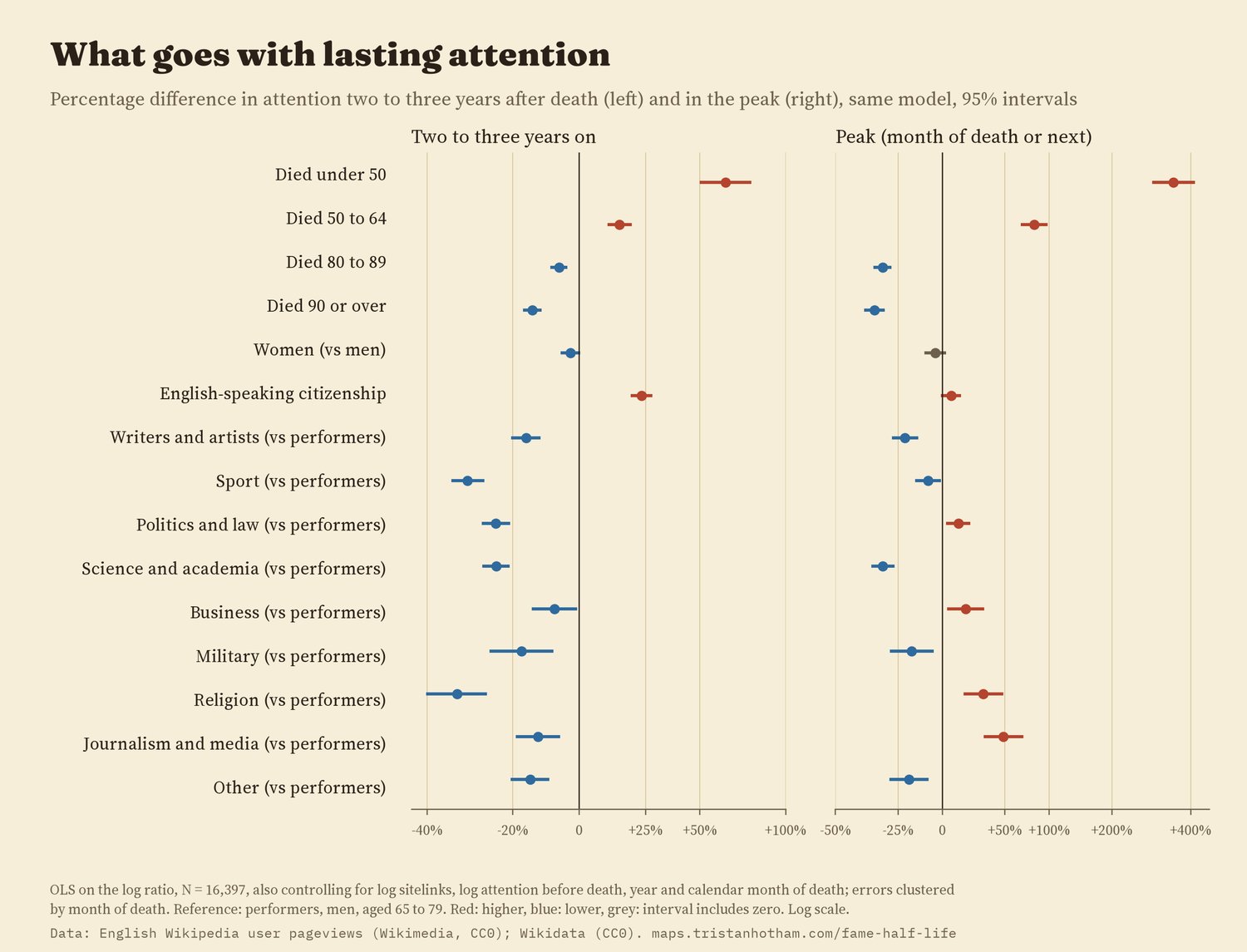
Differences from the main model, with 95% intervals.
05 · Around the worldWhere fame lasts
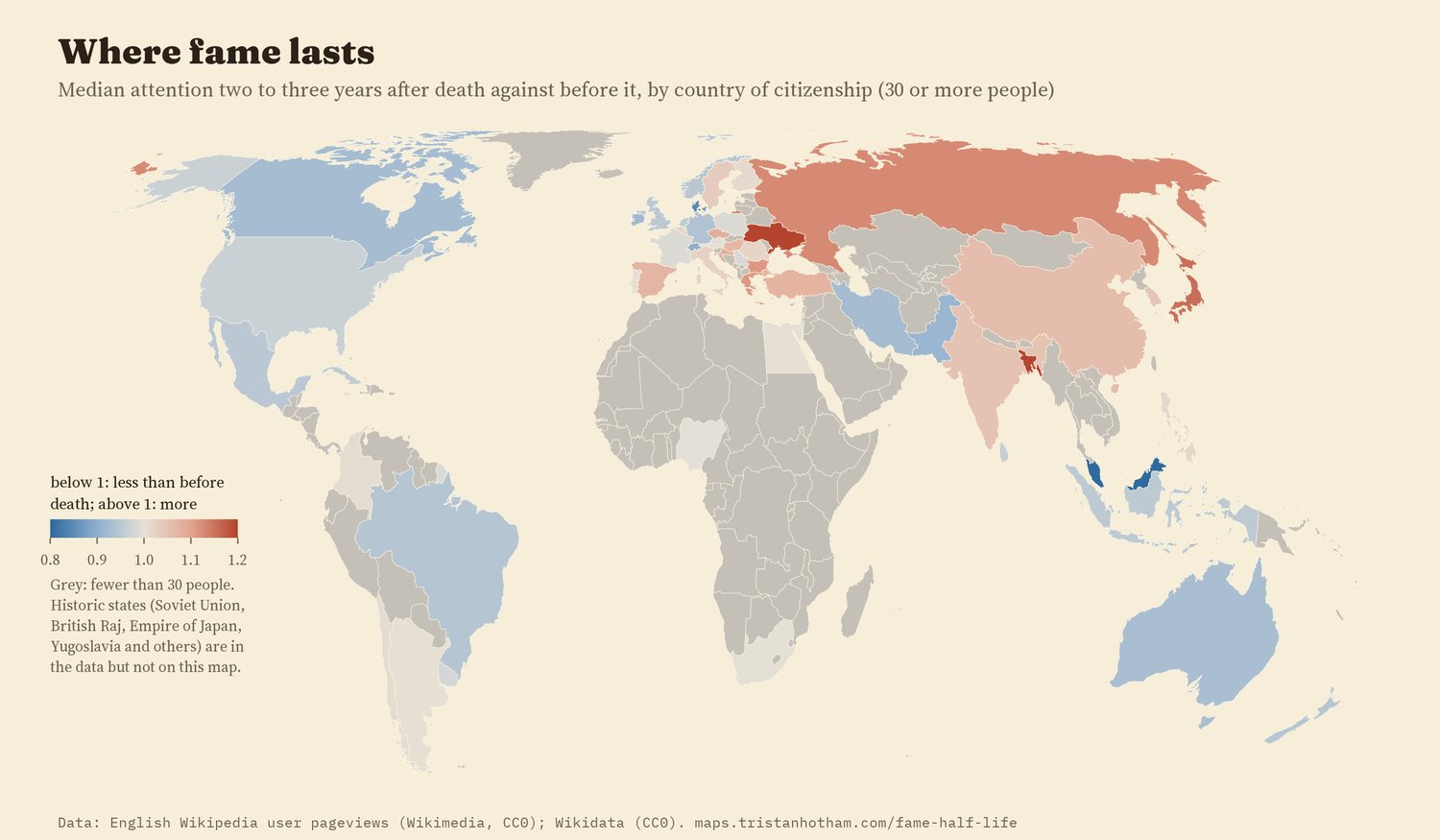
The map shows, for each country of citizenship with at least 30 people, the median attention two to three years after death against before it. It is a map of English Wikipedia's readers as much as of the countries: readers are spread around the world, but English-language coverage is uneven. Tap a country for its numbers.