D-Day was set by the Moon. The planners of June 1944 wanted a Moon near full for the airborne landings in the night, and a low but rising tide soon after dawn; on 6 June the Moon over Normandy was 99.8% lit, and full that evening. Montgomery opened the Second Battle of El Alamein at night under a Moon 99% lit. Commanders have always watched the Moon. But did it shape when battles were fought? I worked out the Moon over every battle in Wikidata with an exact day and a place.
01 · The answerEvery phase, almost equally
Across 9,877 battles, the Moon on the day is spread almost evenly over its cycle. Each eighth of the lunar month holds between 11.8% and 13.0% of the battles, against 12.5% for random days, and a test of all eight together cannot tell the battles from random days (simulated chance of a spread this uneven or more: 0.20). If generals had sought out the full Moon, or the dark of the Moon, it would show here. It does not.
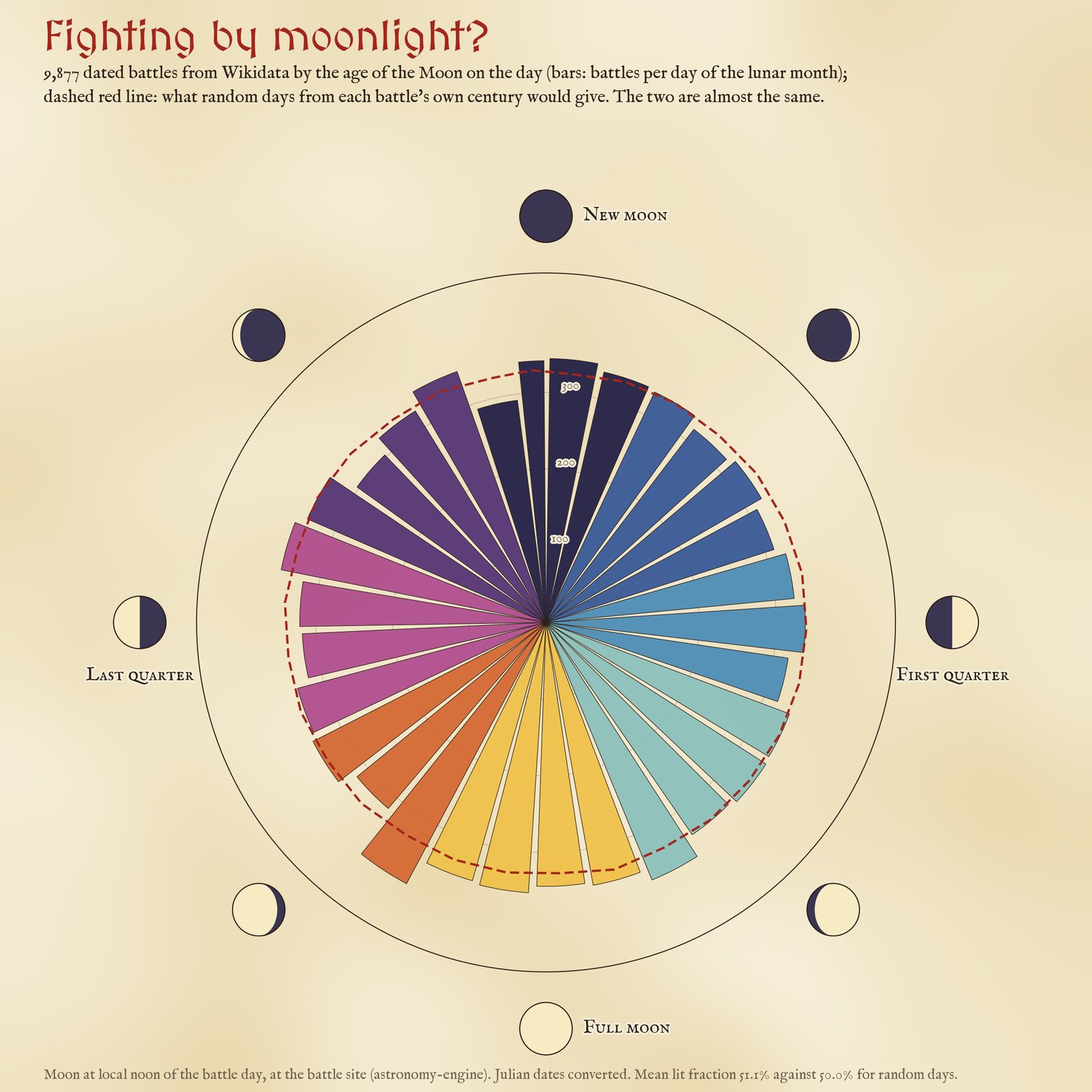
Battles per day of the lunar month, against random days from each battle's own century.
There is one faint tilt. Battle days lean very slightly to the bright half of the month: the Moon was on average 51.1% lit, against 50.0% for random days, and 10.6% of battles fell within a day and a half of full Moon, against 10.0% expected. That is about 63 battles more than chance near the full Moon out of 9,877. A test for a lean towards one side of the cycle finds it (chance 0.02, pointing at full Moon), but it is fragile: it weakens to a chance of 0.05 when sub-battles fought on the same day are counted once, and to 0.16 when only battles with their own coordinates are kept, and I ran several tests on many groups, so one chance near 0.02 is weak evidence. Even taken at face value, it would take only about 2 battles in a hundred deliberately timed for a full Moon.
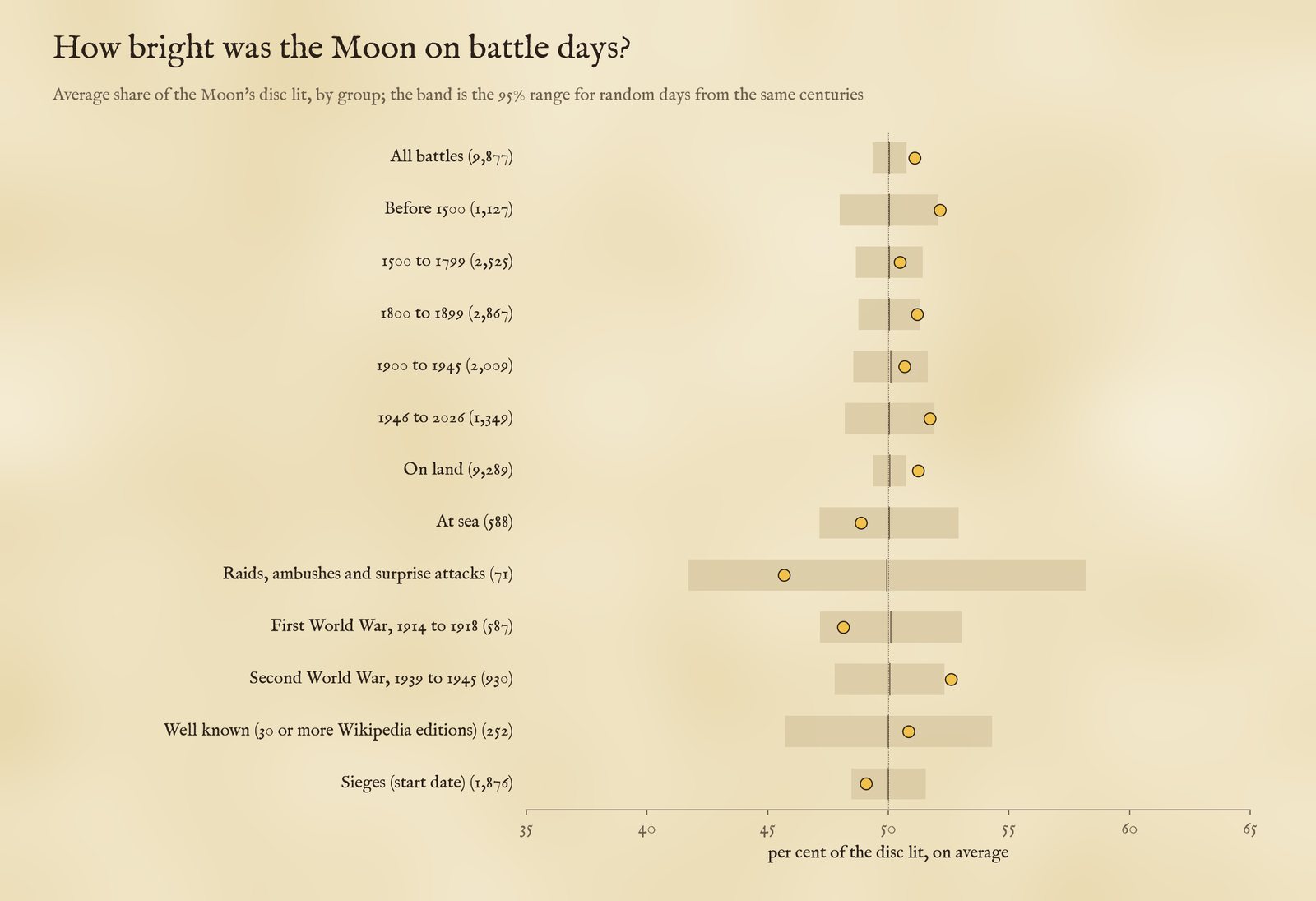
The average share of the Moon's disc lit on battle days, by group, against chance.
02 · Through timeNo era shows a lunar rhythm
I split the battles by era: before 1500, the gunpowder centuries to 1800, the nineteenth century, the age of the world wars, when aircraft and night fighting changed what darkness meant, and since 1946. None shows a clear pattern. The Second World War comes closest: 136 of its 930 battles in Wikidata fell in the full-Moon eighth of the month, against 114 expected, which fits stories of airborne landings and night attacks timed for moonlight, but on its own it is well within what chance produces when you look at enough groups (chance of a lean this strong: 0.07). Battles at sea, where tides and visibility matter, show nothing either (588 battles, 48.9% lit on average).
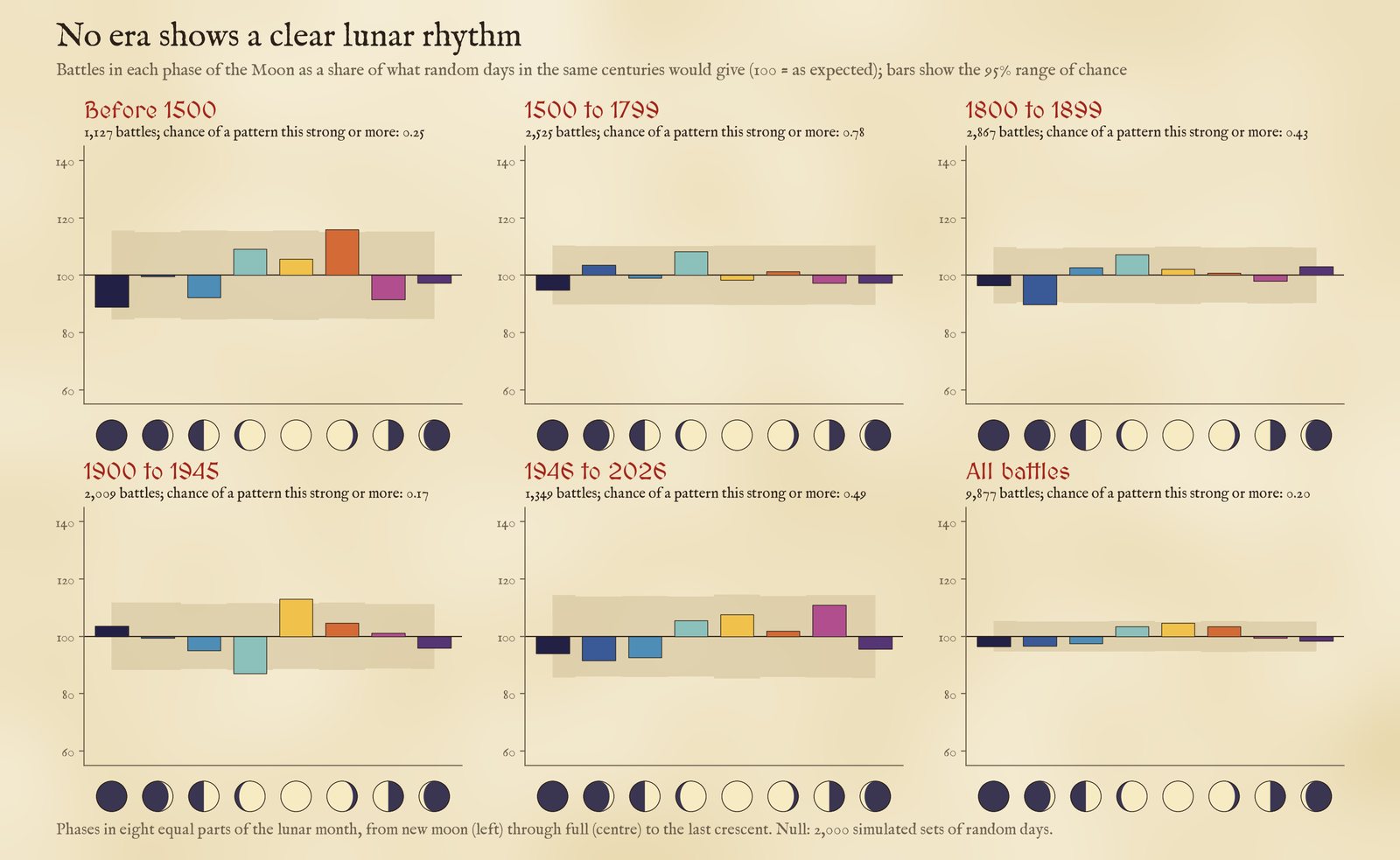
Battles in each phase as a share of what random days would give, by era.
03 · The night beforeMoonlight for the march
Phase is not the whole story. What matters for a night march or a dawn attack is whether the Moon was up in the dark hours, and that depends on the season and the latitude as well as the phase. So for every battle I traced the Sun and the Moon through the night before, every ten minutes, at the battle site, and compared it with random nights at the same place, in the same season, in the same century. On the night before the average battle the Moon was up for 5.19 of 10.2 hours of darkness, against 5.08 hours on random nights: about 6 minutes more, the same faint tilt again. Whether the Moon was still up at sunrise, which matters for a dawn attack, makes no difference at all (49.9% against 49.9%).
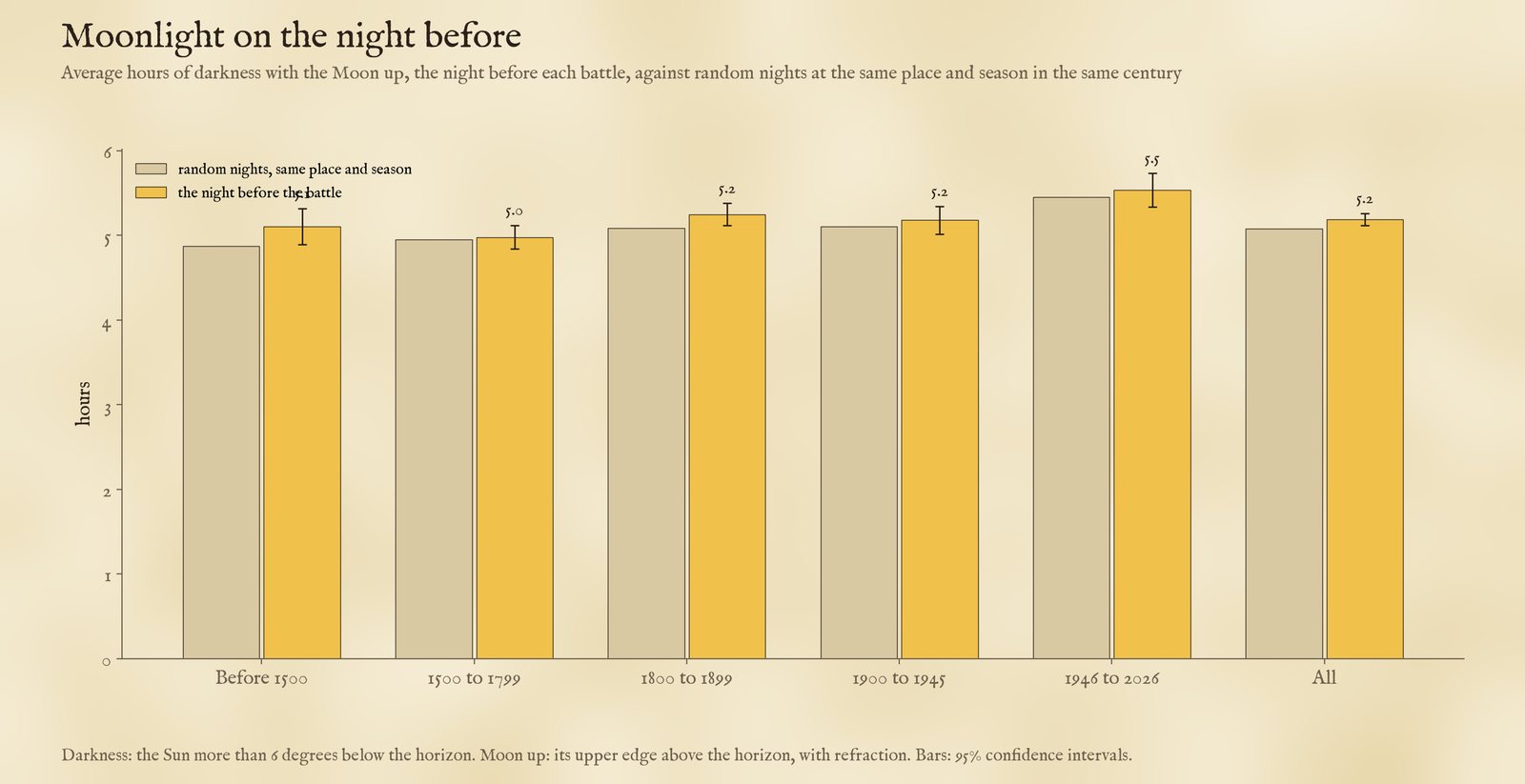
Hours of darkness with the Moon up on the night before, against random nights at the same place and season.
04 · Famous battlesMoons over Hastings, Waterloo and D-Day
Famous battles fell on every kind of night. Hastings and Agincourt were both fought under a last-quarter Moon. Waterloo had a waxing gibbous Moon, 89% lit, though the night before was a wet one. Gettysburg began at full Moon. The first day of the Somme, Trafalgar and Naseby all fell at new Moon. The checks that matter most are where the past recorded the Moon itself: the eclipse of the Moon the night before Pydna in 168 BC (my calculation: full, 100% lit), the eclipse of the Sun that stopped the battle at the Halys in 585 BC (new Moon, 0% lit), the partial eclipse of the Sun during the battle of Isandlwana in 1879 (new Moon), and Badr, fought on the 17th of Ramadan in a lunar calendar (1.5 days after full).
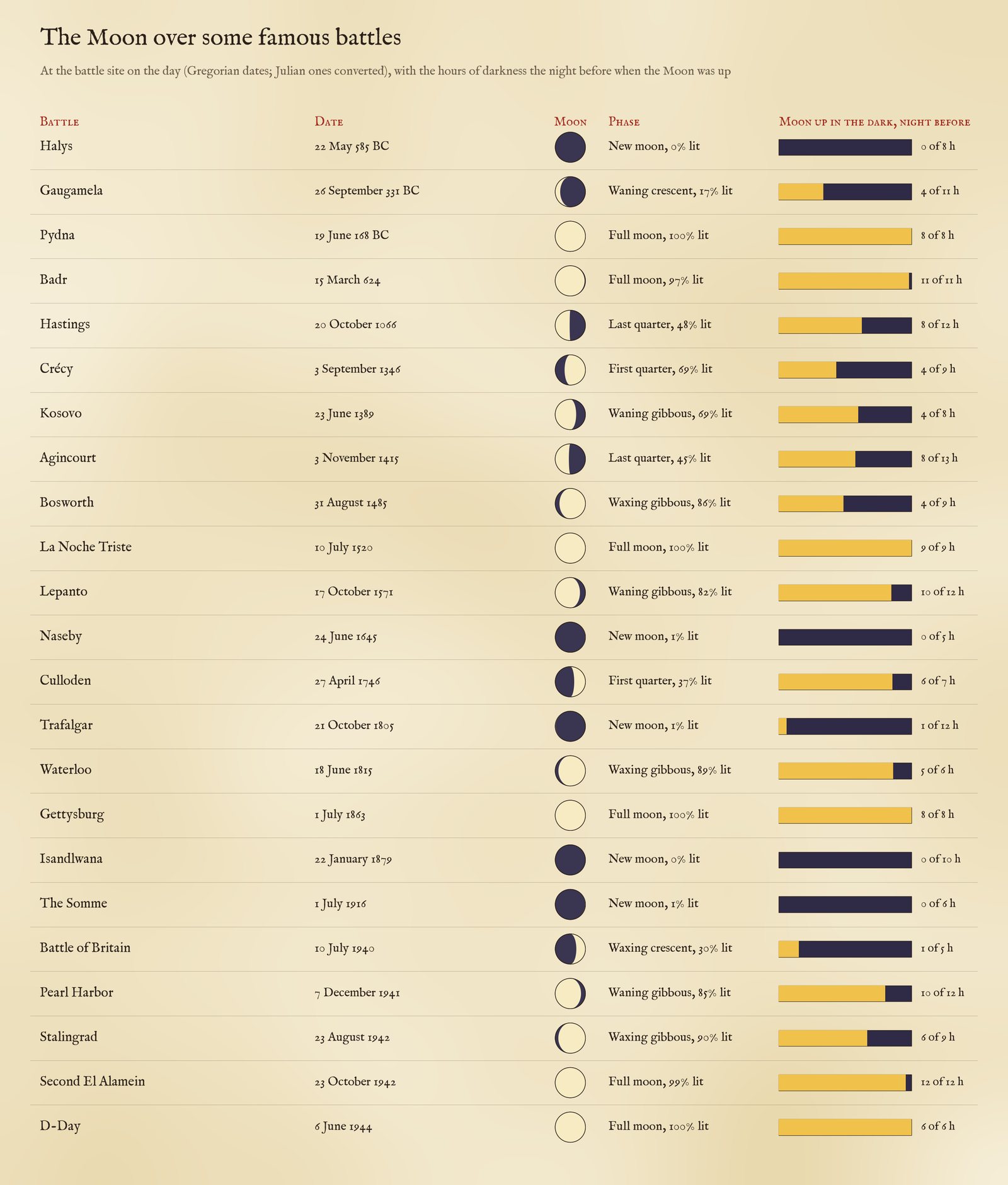
The Moon over some famous battles, with the hours of darkness the night before when it was up.
- Hastings, 1066: last quarter
- Agincourt, 1415: last quarter
- La Noche Triste, 1520: full
- Waterloo, 1815: waxing gibbous
- Gettysburg, 1863: full
- Isandlwana, 1879: new, with an eclipse
- The Somme, 1916: new
- D-Day, 1944: full
05 · How I did thisCalendars, eclipses and a fair null
Battles. From Wikidata I took every item that is a battle (or a kind of battle) with a date to the day and a place: its own coordinates, or else those of its location. Of 12,295 such items, 2,021 are sieges, which last weeks and are kept apart; 183 have dates more than three days apart and are shown but not tested. Where an item has two dates within three days I take the first day of fighting.
Calendars. This is where a study like this goes wrong. Wikidata's query service gives every date converted to the modern (Gregorian) calendar with a flag for the calendar it was entered in, so Hastings, entered as 14 October 1066 in the Julian calendar, is stored as 20 October. But flags are often wrong. Before 1582 almost every date in the sources is Julian, and I found 346 dates entered with a Gregorian flag that are plainly the usual Julian dates (Bosworth on 22 August 1485, Towton on Palm Sunday, 29 March 1461), so I read them as Julian. Britain kept the Julian calendar until 1752, and many English Civil War dates carry the wrong flag: Naseby's 14 June 1645 is the Old Style date, 24 June in the modern calendar. Ten days move the Moon a third of the way round its cycle, from a waning Moon to a new one. I settled 31 such battles by hand and left the other 175 British, Irish and colonial dates before 1752 out of the test, with the 39 dates before AD 1. One more date, Kosovo in 1389, had been converted twice and was corrected by hand. All 21 famous dates I checked by hand come out right.
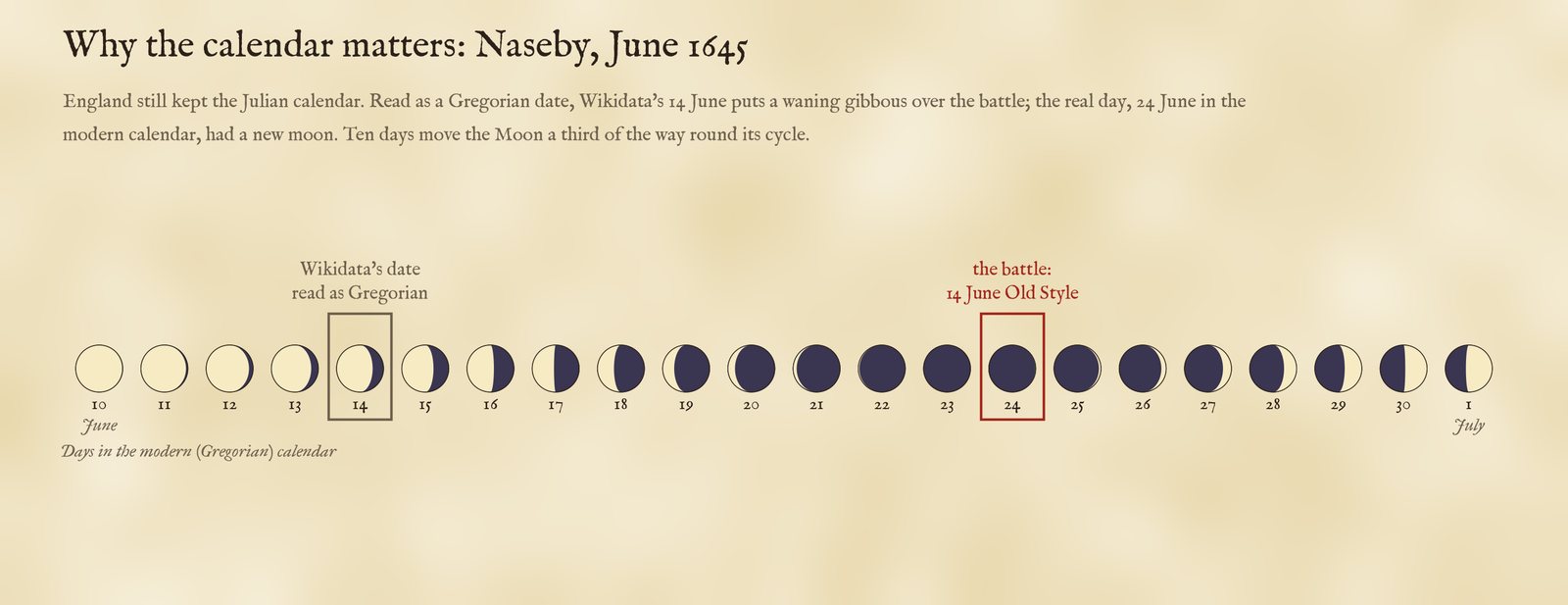
Ten days in June 1645: why the calendar flag matters.
The Moon. I used astronomy-engine to compute, at each battle site, the Moon's phase at local noon on the day, and the Sun and Moon every ten minutes through the night before. A second, independent ephemeris (PyEphem) agrees to within 0.3 degrees on every famous battle. The null. Phases are almost, but not quite, evenly spread over calendar days, so I did not test against an even spread: I drew random days from each battle's own century at its own site, two thousand times over, and compared the battles with those. For moonlight, the random nights also come from the same time of year, since battles are fought more in summer, when nights are short.
What this cannot say. Wikidata's battles are what editors have entered: 63% are from 1800 or later, and Europe dominates. A date is the day a battle is recorded as starting, not the hour fighting began, and some items are campaigns lasting days. Some calendar errors surely remain, but errors scatter the Moon at random, so they can hide a pattern but not create one. The phase of the Moon is one of many things a commander weighs; a near-even spread does not mean nobody used the Moon, only that it rarely decided the date. I wrote more about these battles in Every battle in history.
Sources and licences
- Battles and sieges: Wikidata (CC0), queried with QLever.
- Moon and Sun: astronomy-engine (Don Cross, MIT licence), checked against PyEphem (libastro).
- Base map: OpenFreeMap Positron style, OpenStreetMap contributors (ODbL). MapLibre GL JS 4.7.1 (BSD 3-Clause). Static maps: Natural Earth.
- Derived data CC0, like Wikidata; text and figures CC BY 4.0; code MIT.